
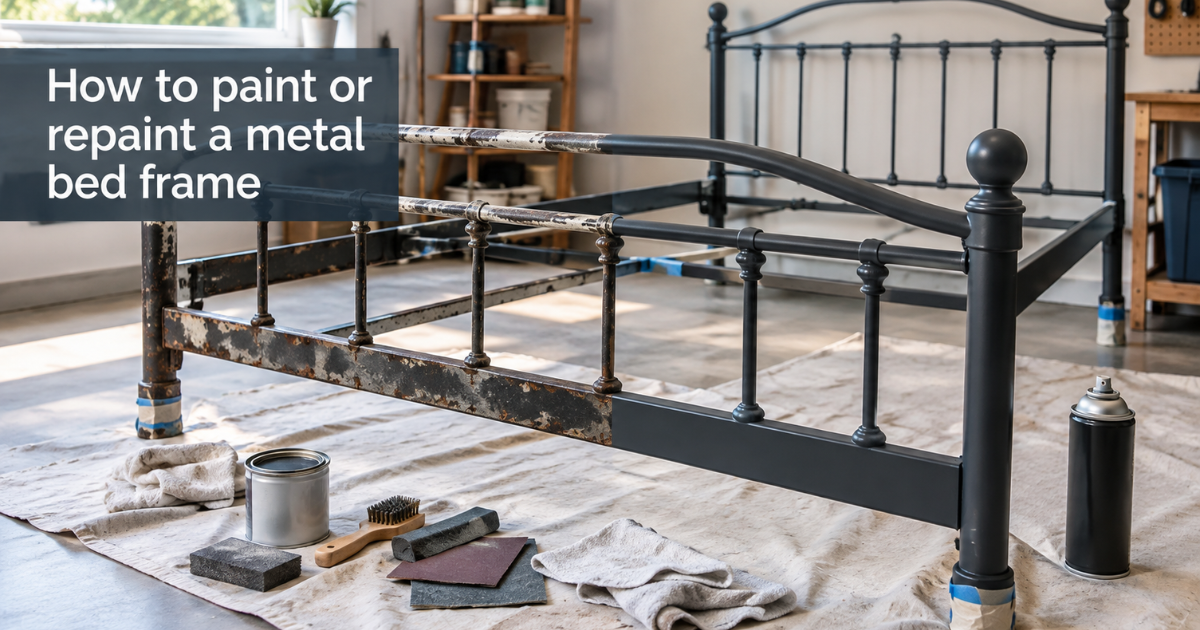
You can paint or repaint a metal bed frame successfully by cleaning the metal, removing loose rust or failing paint, preparing the surface for adhesion, and applying a compatible metal coating in thin, even layers. The amount of sanding and primer you need depends mainly on the condition and type of the existing finish, not simply on the fact that the frame is metal.
Can You Paint or Repaint a Metal Bed Frame?
Yes. Steel, wrought iron, and many other metal bed frames can be refinished, provided the existing surface is sound enough to prepare, and the coating is appropriate for the metal.
The common mistake is treating every old bed frame as if it needs to be stripped completely. That is not always necessary. Benjamin Moore’s current bed-frame guidance says a previously painted metal frame in good condition may not need sanding or primer, while excessive rust or corrosion changes the preparation requirements.
That makes the first decision simple: inspect the frame before choosing your paint system.
Check the Frame Before You Buy Paint
Look closely at the rails, joints, headboard, footboard, and decorative areas. A frame with a firm existing coating, no active rust, and no peeling edges requires much less work than one covered with flaking paint and corrosion.
Steel and wrought iron are ferrous metals, which means rust is an important concern. Aluminum and other non-ferrous metals behave differently and may need different preparation or primer choices. Krylon specifically separates ferrous and non-ferrous metals in its metal-painting guidance.
Also check whether the current finish is glossy. A glossy surface can make adhesion more difficult, so the goal is not always to remove every bit of paint but to create a clean, sound, and appropriately prepared surface.
What Preparation Does a Metal Bed Frame Actually Need?
Preparation is the part of the project that most strongly affects the final result.
Start by removing bedding, mattress components,s and anything that should not be exposed to dust or overspray. Disassembling the frame is usually worth the effort because individual sections are easier to clean and coat evenly.
Next, remove dirt, dust, grease, and other contamination. Benjamin Moore notes that oil and other contaminants can interfere with adhesion, while Krylon recommends starting with a clean, dry surface.
After cleaning, inspect the old coating. Loose paint should come off. Rust should be removed from affected areas rather than simply covered with a decorative color coat. A wire brush or suitable sandpaper can be used for loose rust and failing coatings.
The objective is a stable surface, not necessarily bare metal everywhere.
When You Can Keep the Existing Paint
Repainting over an existing finish can be perfectly reasonable when the old coating is firmly attached, free of significant rust, and properly cleaned.
A light preparation may be enough to dull a glossy surface and smooth minor imperfections. Benjamin Moore’s current guidance specifically says that a previously painted metal bed frame in good condition may be repainted without completely removing its existing coating.
This approach saves time and reduces unnecessary stripping.
The exception is a coating that is peeling, bubbling, severely cracked, or rusting underneath. New paint cannot reliably fix a failing base.
When Rust or Peeling Paint Changes the Prep
Rust deserves separate attention because painting over loose corrosion can leave you with a fresh-looking surface that fails underneath.
Remove loose rust mechanically with appropriate abrasive material or a wire brush. Then clean away the resulting dust before priming or painting. Krylon recommends removing loose rust and previously applied loose coatings before proceeding, while its primer guidance describes corrosion protection as a reason for using an appropriate metal primer.
For severe corrosion, the project may also require more extensive repair rather than simple repainting. Deeply weakened metal, major perforation,n or structural damage is not a cosmetic paint problem.
Choosing Between Spray Paint, Brush and Roller
Spray paint is often convenient for an ornate metal bed because it reaches spindles, curves, scrollwork, and narrow spaces that can be awkward with a brush. It also makes it easier to build thin coats across complex shapes.
A brush gives you more control and can be practical for detailed touch-ups, small frames,s or a workspace where overspray would be difficult to manage. Rollers are more useful on larger flat surfaces such as broad headboard or footboard sections. Benjamin Moore specifically recommends rollers for larger flat areas and brushes for legs and difficult details.
The best method is therefore determined by the frame design and your workspace rather than by a universal rule.
How to Paint or Repaint a Metal Bed Frame
Prepare and Disassemble the Frame
Remove the mattress and bedding, then separate the bed into manageable sections where practical. Keep bolts, washers, and other hardware together so they return to the correct locations.
Working on separate pieces also lets you rotate each section during preparation and painting, reducing missed areas.
Clean Away Dirt, Grease and Dust
Clean the frame thoroughly and allow it to dry completely. Dirt or oily residue left under the new coating can reduce adhesion and cause an otherwise good paint job to fail prematurely.
Do not rush into sanding a dirty frame. Abrading contamination into the existing finish can make the preparation harder rather than better.
Remove Loose Rust and Failing Paint
Use a wire brush, sandpaper, or an appropriate rust-removal method for affected areas. Sand away loose paint edges so there is not a sharp transition between failing coating and sound coating.
You do not need to remove every square inch of old paint merely because you are repainting. The surface needs to be stable, clean,n and appropriate for the new coating.
Create the Right Surface for Adhesion
If the frame is glossy, lightly abrading it can help dull the surface. Benjamin Moore’s current guidance for metal bed frames also notes that medium sanding is useful for appropriate preparation, while a sound previously painted metal frame may not need full stripping.
After sanding, remove all dust.
This is where many DIY projects quietly go wrong. A frame can look clean from across the room while still carrying fine abrasive dust that affects the next coating.
Prime Where the Metal Needs It
Primer should be treated as a condition-based step rather than a ritual.
A clean frame without loose rust may not require a separate primer if the selected product is specifically designed for that application. Benjamin Moore notes this possibility for clean, sound metal bed frames.
Rusty, bare, or heavily corroded metal deserves more careful priming. Krylon’s current guidance recommends metal primer for rust protection and improved preparation, while Benjamin Moore recommends dedicated metal primers for frames with excessive rust or corrosion.
The exact primer and recoat timing should come from the coating manufacturer’s instructions because products differ.
Apply Thin, Even Paint Coats
Whether spraying or brushing, avoid trying to achieve full coverage in one heavy pass.
Thin coats give you better control over runs, drips, and uneven buildup. This matters especially on decorative iron beds where vertical rails can collect excess coating.
Spray-paint manufacturers also emphasize applying multiple thin coats rather than creating heavy runs.
Keep your application pattern consistent and allow the product to dry or recoat according to the label rather than relying on a generic timing rule.
Let the Finish Dry and Cure Properly
“Dry to the touch” and “ready for normal use” are not always the same thing.
A bed frame is a high-contact piece of furniture. Rails, joints, and connection points experience movement and friction, so assembling the frame too soon can damage a coating that feels dry but has not developed sufficient final durability.
Product-specific drying, handling and recoat times vary. Follow the instructions for the exact primer and paint you use.
Reassemble Without Damaging the New Finish
Before putting the frame back together, inspect the edges, bolt holes, and connection points.
Do not aggressively drag freshly painted metal across floors or force tightly fitted hardware against uncured paint. Where appropriate, wait until the manufacturer’s recommended handling and cure period has been reached.
Do You Always Need Primer?
No.
The need for primer depends on the condition of the substrate, the existing coating, and the paint system being used. Benjamin Moore says clean, previously painted metal bed frames in good condition may not require primer, while heavily rusted or corroded surfaces need dedicated metal primer.
Krylon also sells paint systems designed to reduce preparation, including products marketed as paint-and-primer combinations. However, product shortcuts should never be treated as universal rules; the label for the specific coating determines the required preparation.
How to Paint a Rusty Metal Bed Frame
A rusty bed frame needs more attention before color is applied.
Remove loose rust first and determine whether the corrosion is superficial or has damaged the underlying metal. Surface rust can often be addressed during preparation, but significant corrosion may signal a structural problem.
Once loose corrosion is removed, the surface should be cleaned, dried,, and coated with a product intended for the metal condition. Krylon’s current guidance recommends rust-protective primer systems for metal, while Benjamin Moore recommends dedicated metal primers when corrosion is significant.
The key lesson is simple: paint should finish the repair, not hide an unresolved metal problem.
Why Metal Bed Frame Paint Peels, Drips or Chips
Peeling usually points back to preparation or compatibility. Common causes include grease left on the metal, loose old paint underneath, excessive gloss, rust that was not properly addressed, incompatible coatings, or painting under conditions outside the product’s recommended range.
Drips have a different cause: too much wet material in one pass.
This is why thin applications matter. The goal is controlled film thickness rather than maximum coverage immediately.
Another overlooked failure point is handling. A beautifully painted frame can still be damaged if it is assembled before the finish has adequately dried and cured.
How to Get a Smoother Finish on Detailed Bed Frames
Decorative iron beds have a hidden difficulty: they contain many edges, corners, and vertical sections that can collect excess paint.
Spray application can be particularly useful for these shapes, but only when the operator controls distance, movement, and overspray. A brush can produce excellent results too, especially when the painter works carefully on smaller sections and avoids repeatedly brushing partially dried paint.
The surface underneath also matters more than the final color. Paint will not hide deep rust pits, rough flakes, or badly failing coatings as neatly as people often expect.
For a smoother result, spend more effort making the substrate uniform before worrying about the final sheen.
Is It Better to Spray or Brush Paint?
Neither method is universally better.
| Factor | Spray Paint | Brush/Roller |
| Detailed scrollwork | Very useful | Good with the right brush |
| Large flat areas | Fast | Good control |
| Overspray | Higher concern | Lower |
| Workspace requirements | More demanding | Simpler |
| Touch-up control | Moderate | Excellent |
| Consistency on thin coats | Excellent when applied correctly | Depends strongly on technique |
| Best fit | Ornate or complex frames | Smaller jobs and controlled application |
For a highly decorative iron bed, spraying can reduce the difficulty of reaching narrow areas. For a simple frame or a limited workspace, brushing may be more practical.
Safety Matters More Than the Paint Brand
Spray painting should be done in an appropriately ventilated area, with overspray controlled and the manufacturer’s safety instructions followed.
EPA guidance recommends increasing ventilation when using products that emit VOCs and following product-label precautions. OSHA materials also identify inhalation exposure to paint and solvent vapors as a hazard in spray-painting environments.
For a bed frame, outdoor or otherwise suitable, well-ventilated work areas can be preferable when the coating label permits it. Avoid spraying in a confined bedroom simply because the furniture normally lives there.
Is Repainting Better Than Replacing the Bed Frame?
Repainting makes sense when the frame is structurally sound, and the main problem is its appearance or surface condition.
A fresh finish can change the style of an older frame without replacing a usable piece of furniture. It can also make a second-hand frame fit a new bedroom more effectively.
Replacement becomes a different question when the metal has serious structural damage, badly compromised joints, or corrosion that affects strength. Paint can improve appearance, but it cannot restore severely weakened metal.
The practical decision is therefore based on the frame’s structural condition first and cosmetic condition second.
Conclusion
Repainting a metal bed frame can be a simple way to refresh an old piece of furniture without replacing it. The key to a durable finish is careful preparation: clean the metal thoroughly, remove loose rust or peeling paint, prepare glossy surfaces for adhesion, use primer where the metal or coating requires it, and apply thin, even coats of suitable paint. Take your time with drying and curing before reassembling the frame. With the right preparation and application method, a worn metal bed frame can achieve a smooth, attractive finish that looks refreshed and is better protected for continued use.
You may also like: How to Stop an Iron Bed From Squeaking
FAQs
Can I paint a metal bed frame without sanding it?
Sometimes. A sound, previously painted metal bed frame may not require sanding, according to Benjamin Moore’s current guidance. Glossy, peeling, rusty, or otherwise compromised surfaces need more preparation.
Should I avoid repainting a metal bed frame if it has rust?
Not necessarily. Surface rust can often be addressed during preparation, but significant corrosion should be inspected for structural damage before painting. Paint is not a substitute for repairing weakened metal.
Will repainting a metal bed frame affect it long term?
A properly prepared and compatible coating can provide a refreshed appearance and protection, but durability depends on the substrate, coating system, application, and later handling. The weakest part of the system is often poor preparation rather than the color itself.
What do people often overlook when painting an iron bed?
The difficult areas are usually connection points, narrow decorative sections, underside edges,s and places where hardware rubs against the new finish. These areas deserve inspection before reassembly.
Is spray paint the best choice for every metal bed frame?
No. Spray paint is convenient for complex decorative shapes, but brush or roller application can provide better control in smaller workspaces and on simpler designs. The frame’s shape and your working environment should determine the method.