The easiest way to stop an iron bed from squeaking is to find the exact point where metal parts are moving against each other, then tighten, lubricate, cushion, or stabilize that area. Start with the bolts and joints, but also check the legs, floor, slats, mattress, and foundation because the frame is not always the source of the noise.
Why Is My Iron Bed Squeaking?
An iron or metal bed usually becomes noisy because two parts move slightly under pressure and create friction or vibration. Loose bolts and screws are a common cause, particularly as a frame is used and its joints gradually develop more movement. Sleep Foundation also identifies loose joints, friction between components, and contact between the bed and floor as possible sources of unwanted noise.
The important point is that a squeak is a symptom, not a diagnosis. Tightening one bolt may help if that joint is responsible, but it will not solve a noise coming from a mattress, foundation, slat, leg, or another frame connection.
Find the Exact Source Before Fixing It
Remove unnecessary bedding and, if practical, have one person slowly sit, shift, or move on the bed while another person listens.
Pay attention to where the sound appears. Check the headboard connections, side rails, center supports, slats, legs, and corners. Then test the mattress and foundation separately if possible.
This simple test can save time. If the noise occurs when pressure is applied directly to the mattress away from the frame, the mattress or foundation may be responsible. If the sound clearly comes from a corner or joint of the iron frame, concentrate your repair there.
Tighten Every Loose Bolt and Screw
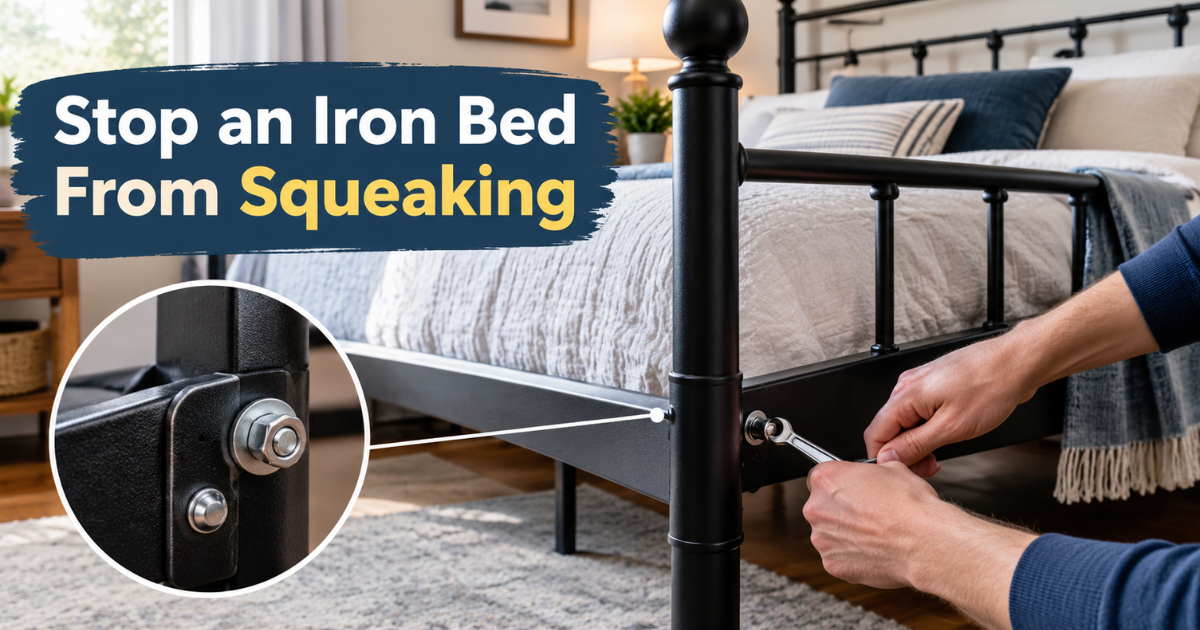
Once you locate the noisy area, inspect the fasteners. Use the correct wrench or screwdriver and tighten loose bolts and screws carefully.
Do not simply tighten one visible bolt and stop. Inspect the other frame connections as well because a second loose joint can continue to move and produce noise.
Avoid excessive force. A fastener needs to hold the joint securely, but forcing a bolt beyond what the frame or manufacturer’s instructions allow can damage threads or hardware.
Proper assembly and sufficiently tightened screws are also recommended as a way to reduce noise in metal bed frames.
Reduce Metal-on-Metal Friction
If tightening the joint does not completely solve the squeak, friction may be the problem.
A suitable lubricant can be applied to an appropriate metal joint or moving connection, following the product’s instructions and the bed manufacturer’s recommendations. Sleep Foundation lists lubrication as one option for noisy metal frame joints.
Apply only enough product to address the contact point. Excess lubricant can spread onto bedding, flooring, or other surfaces.
It is also useful to clean dirt or accumulated debris from the joint before treating it. A dirty connection can make it harder to determine whether the actual problem is looseness, friction, or both.
Add Washers or Padding Where Parts Rub
Sometimes a joint is tight but still allows two hard surfaces to contact each other during movement.
A plastic washer can help separate metal components at an appropriate fastener connection. Sleep Foundation specifically notes that plastic washers may reduce the metal-on-metal connection associated with squeaking.
Thin felt, or other suitable cushioning, can also help where the mattress, foundation, or another component rubs against the frame. The material should not interfere with the structural connection or prevent the bed from sitting securely.
The goal is not to cover the entire bed with padding. The better approach is to identify the exact rubbing point and address that point.
Check the Legs and Floor Contact
A squeak can sometimes come from movement between the bed and floor rather than from the iron frame itself.
Push gently against the bed and check whether it rocks. If one leg does not sit evenly, the frame can shift slightly whenever weight is applied.
Furniture pads or another suitable stabilizing material under the affected leg may reduce movement. Sleep Foundation also recommends checking whether the bed is level and whether padding is needed between the frame and floor.
Do not use a loose object that could make the bed unstable. The support should remain firm and even.
Don’t Forget the Slats, Mattress and Foundation
A common mistake is assuming that every squeak from an iron bed comes from the iron itself.
The mattress, box spring, foundation, or slats can also create noise. Innerspring and hybrid mattresses contain metal components that can become noisy, while foundations can develop noise from their own internal components.
A useful diagnostic test is to remove the mattress and test the frame by itself. If the frame is quiet without the mattress but noisy when the mattress and foundation are restored, investigate the contact points between those components.
This approach is more reliable than repeatedly tightening random bolts.
What If the Squeak Comes Back?
If the bed becomes quiet after tightening but starts squeaking again soon afterward, look for repeated movement rather than treating the noise as a one-time loose bolt.
Check whether the frame rocks, whether a joint is worn, whether a fastener is no longer holding securely, or whether two components are repeatedly rubbing together.
Also inspect the frame for visible damage, bent components, cracked welds, severely worn hardware, or other structural problems. A squeak accompanied by noticeable instability deserves more attention than an isolated, minor noise.
A Simple Squeak-Fixing Order to Follow
For most iron beds, work through the problem in this order:
First, locate the noise.
Second, tighten the relevant bolts and screws.
Third, check for metal-on-metal friction.
Fourth, use an appropriate lubricant or washer where suitable.
Fifth, inspect the legs and floor contact.
Sixth, test the mattress, foundation, and slats separately.
This order starts with simple, reversible fixes before moving toward more involved repairs.
When a Squeaky Iron Bed Needs More Than a Quick Fix
A squeak by itself does not necessarily mean the bed needs replacement. A loose connection or small friction point can often be addressed without replacing the frame.
Replacement becomes more reasonable when the frame has significant structural damage, persistent instability, badly worn connections, or components that can no longer be secured properly.
Before replacing the entire bed, identify the actual failed component. If the mattress or foundation is responsible for the noise, replacing an otherwise sound iron frame would not address the underlying problem.
Is Replacing the Bed Frame Necessary?
Not usually as a first step. A properly assembled metal frame can remain usable even when it develops noise, provided its joints and structural components remain sound.
The better question is not simply, “Is my bed squeaking?” but “Why is it squeaking?”
If the cause is a loose fastener, friction, uneven floor contact, or a small rubbing point, repair may be sufficient. If the noise comes with serious movement or visible structural damage, replacement or professional assessment may be more appropriate.
Conclusion
A squeaky iron bed does not always mean you need a new bed frame. In most cases, start by finding the exact source of the noise, then check loose bolts, metal joints, rubbing surfaces, floor contact, slats, and the mattress or foundation. Tightening the right connection, reducing friction, or stabilizing a moving part can often make the bed quieter without replacing the entire frame.
If the squeaking keeps returning or is accompanied by noticeable instability or structural damage, inspect the frame more carefully before continuing to use it. The key is to fix the cause of the squeak rather than simply trying to hide the sound.
You may also like: Iron Beds vs Wooden Beds
FAQs
Can I stop an iron bed from squeaking without taking it apart?
Often, yes. Start by tightening accessible bolts and screws, checking the legs, and identifying visible rubbing points. If the noisy joint cannot be reached properly, partial disassembly may be necessary.
Should I avoid using lubricant on an iron bed?
Not necessarily, but use it only where appropriate and follow the lubricant and bed manufacturer’s instructions. Apply a small amount to the relevant metal connection rather than spraying the entire frame.
Will a squeaky iron bed get worse over time?
It can if the underlying movement continues. A recurring squeak may indicate that a connection is repeatedly loosening, rubbing, or shifting, so finding the cause is more useful than repeatedly masking the sound.
What if the bed squeaks only when I turn over?
That pattern suggests the noise is triggered by movement under load, but it does not identify the exact component. Test the frame, mattress, foundation, and floor contact separately to locate the source.
Do I need a new bed frame if tightening the bolts does not work?
No. Tightening is only one possible solution. Next, check friction, washers or cushioning, leg stability, floor contact, slats, mattress, and foundation. Replacement becomes more relevant if there is structural damage or persistent instability.