
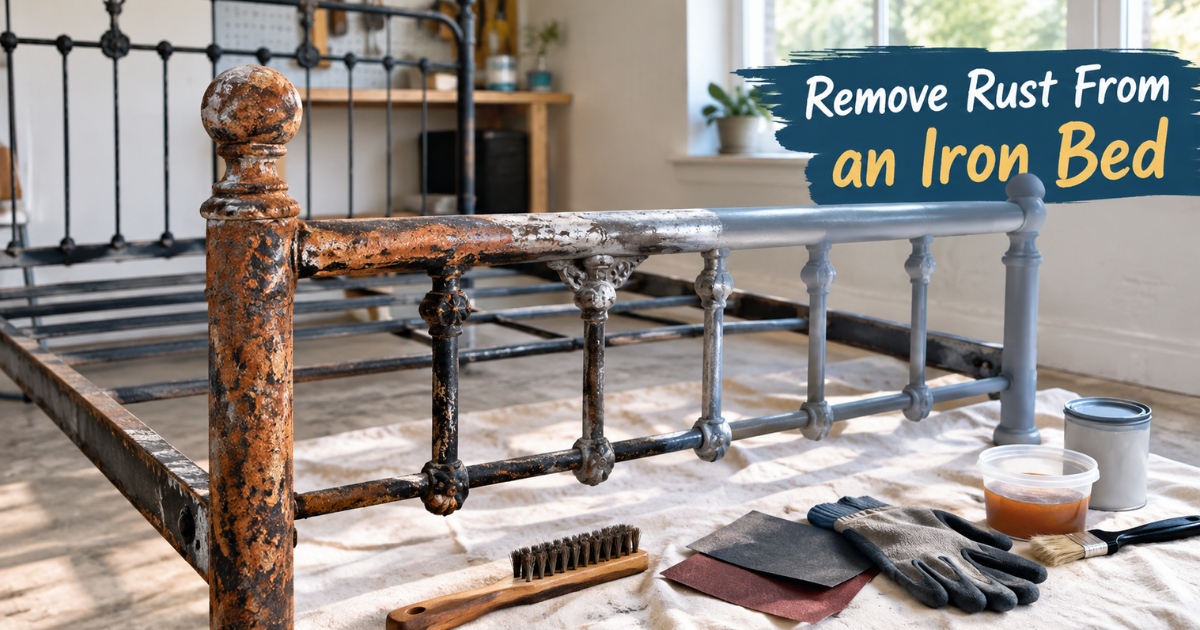
Learning how to remove rust from an iron bed starts with removing loose corrosion, cleaning the metal thoroughly, treating stubborn rust where necessary, and completely drying the surface before applying a protective primer. For light to moderate surface rust, a wire brush, sandpaper, careful cleaning, and an appropriate metal primer can often restore the frame without replacing it.
What Causes Rust on an Iron Bed?
Rust develops when iron-containing metal is exposed to moisture and oxygen. Bed frames are particularly vulnerable around joints, scratches, damaged paint, screw holes, and areas where condensation or humidity repeatedly reaches the metal.
A small orange patch does not necessarily mean the entire bed is badly damaged. The important question is whether the corrosion is sitting on the surface or has created deep pitting, holes, or damage around a structural joint.
That distinction matters because surface rust can often be cleaned and treated, while severe corrosion may require repair or replacement of the affected section.
How to Tell Surface Rust From Serious Corrosion
Surface rust usually appears as orange, brown, or reddish deposits that can be loosened with brushing or sanding. The metal underneath may still have a relatively solid shape once the corrosion is removed.
More serious corrosion can leave deep pits, thin sections, flaking metal, or holes. Pay particular attention to the legs, side rails, center supports, and connection points because these areas contribute to the bed’s stability.
Do not assume that making heavily rusted metal look cleaner has restored its original strength. Cleaning changes the surface; it does not automatically rebuild metal that has already been lost.
Prepare the Bed Before Removing Rust
Remove the mattress, bedding, and anything else that could become contaminated with dust or rust particles. For a frame that can be safely disassembled, separating the major sections makes it easier to reach joints and hidden areas.
Move the work outside or into a well-ventilated workspace and protect the floor beneath the frame. Wear suitable eye protection and gloves, particularly when brushing or sanding corrosion.
Before using any rust-removal chemical on an older or decorative bed, test your chosen method on a less visible section first. Historic metal-care guidance recommends testing a cleaning method before applying it broadly because the wrong treatment can affect surrounding finishes or materials.
Remove Loose Rust With a Wire Brush
Start with mechanical removal rather than immediately reaching for a strong chemical treatment. A stiff wire brush can break away loose rust and peeling coating, while steel wool can be useful on smaller or more delicate areas.
Work patiently instead of trying to strip the entire frame in one aggressive pass. The goal is to remove loose corrosion and expose the areas that need additional treatment.
For ornate iron beds, curved sections and decorative joints often hold rust where a large brush cannot reach. Smaller brushes or fine steel wool can make those areas easier to clean without unnecessarily damaging the surrounding surface.
Mechanical rust removal with a wire brush, steel wool, or sandpaper is also commonly recommended for metal furniture restoration.
Sand the Remaining Corrosion
After brushing, inspect the metal in good light. Sand the remaining rough areas to smooth the transition between cleaned metal and the surrounding surface.
You do not necessarily need to strip every square inch of an intact painted frame to bare metal. Focus on removing loose corrosion, unstable paint, and rough edges so the repaired area has a sound surface for the next stage.
If sanding exposes significant pitting or reveals that the metal has become unusually thin, stop and assess whether the frame still provides adequate structural support.
When Should You Use Vinegar or a Rust Remover?
For small removable parts and light rust, white vinegar is one possible household treatment. Some metal-maintenance guidance specifically lists white vinegar and baking soda as rust-removal options when used with mechanical cleaning.
The key is controlling moisture afterward. Once an acidic treatment has loosened rust, the metal needs to be cleaned according to the method used and dried thoroughly. Leaving damp metal sitting overnight can undermine the entire restoration.
For more stubborn corrosion, a commercial rust remover may be more practical. Product instructions vary, so use the exact application, dwell time, rinsing, and drying directions supplied by the manufacturer rather than copying a universal timing from another product. Rust-Oleum, for example, states that its Rust Dissolver is designed for iron and steel and instructs users to keep the solution wet during treatment and prevent it from drying on the surface.
Never combine different rust-removal chemicals simply because they are each recommended separately. Treat each product according to its own label.
Clean and Dry the Metal Before Priming
Once the rust has been removed, clean away dust, loosened particles, residue, and other contaminants.
This is the stage where patience matters. The metal should be completely dry before you apply a primer. Moisture trapped around joints, seams, or decorative crevices can become a starting point for new corrosion.
Inspect the frame again before priming. If you can still see loose rust, unstable paint, or residue, deal with those problems first instead of covering them with a new coating.
Prime and Repaint the Iron Bed
A properly prepared metal surface gives the protective coating a much better chance of performing as intended.
Choose a primer designed for the condition of your metal. For example, Rust-Oleum’s Clean Metal Primer is intended for bare, lightly rusted, or previously painted metal, while its Rusty Metal Primer is designed for more heavily rusted surfaces and is described as helping block moisture that contributes to corrosion.
Apply the primer according to the manufacturer’s directions and allow the specified drying or curing time before applying the topcoat.
After the primer has cured properly, use a paint intended for metal furniture. Thin, even coats are generally easier to control than one heavy application, especially on decorative iron beds with curves and narrow sections.
How to Prevent Rust From Coming Back
Rust prevention begins with controlling moisture. Keep the bed away from persistent dampness, repair chips or scratches in the protective coating before they become larger exposed areas, and pay extra attention to joints and concealed sections.
Regular inspection is more useful than waiting until rust becomes obvious. A small orange spot is usually easier to address than a large area of peeling paint and deep corrosion.
If the bed is kept in a humid environment, check the lower sections, feet, joints, and areas close to walls or windows more frequently.
Mistakes That Can Make Rust Worse
One common mistake is painting over loose rust. A fresh topcoat may make the frame look better temporarily, but unstable corrosion beneath the coating remains a surface-preparation problem.
Another mistake is leaving the metal damp after washing or rust treatment. Rust removal should end with a clean, dry surface rather than a frame that is immediately exposed to moisture again.
Using excessive pressure is another risk, especially on older decorative ironwork. The objective is to remove corrosion without unnecessarily damaging sound metal or surrounding finishes.
It is also a mistake to assume that every rusty bed needs the same treatment. A few surface spots call for a different approach from widespread pitting or corrosion around structural connections.
When Rust Removal Is No Longer Enough
If corrosion has created holes, severely thinned a structural rail, damaged a major support, or compromised a critical joint, cosmetic rust removal should not be treated as a complete repair.
At that point, the important question is no longer simply how to remove the rust. It is whether the remaining metal is structurally sound enough to support normal use.
A carefully restored finish can improve appearance and help protect sound metal, but it cannot replace metal that has already been lost.
For a valuable antique or historically significant iron bed, a specialist restoration assessment may also be appropriate before aggressive cleaning or repainting. Historic metal-care guidance recommends selecting cleaning methods carefully and protecting adjacent materials during restoration work.
Conclusion
Removing rust from an iron bed does not have to be complicated. The key is to remove loose corrosion carefully, smooth the remaining surface, clean and dry the metal completely, and then protect it with a suitable primer and paint. Regularly checking joints, scratches, and exposed areas can also help prevent rust from returning. When corrosion has caused deep pitting, holes, or weakened structural parts, cleaning alone is not enough, and the frame should be properly assessed before continued use.
You may also like: How to Paint or Repaint a Metal Bed Frame
FAQs
Can I remove rust from an iron bed without repainting it?
Yes, light surface rust can sometimes be cleaned without repainting, but exposed bare metal remains vulnerable to new corrosion. A protective coating is usually appropriate when the original finish has been removed.
Should I avoid vinegar on an old iron bed?
Not automatically, but test first. Vinegar is acidic and should be followed by appropriate cleaning and thorough drying. Older decorative finishes may require a gentler restoration approach.
Will removing rust make a badly corroded bed structurally safe again?
No. Rust removal can clean and prepare the surface, but it cannot restore metal that has already been lost through severe corrosion.
What part of an iron bed is easiest to overlook?
Joints, screw holes, underside sections, and decorative crevices are easy to miss. These areas deserve an extra inspection before the final primer and paint.
Should I use a rust converter instead of removing rust completely?
A rust converter can work for suitable remaining rust, but it isn’t a universal substitute for surface preparation. Still remove loose rust and unstable material, and follow the converter’s instructions exactly.