An iron bed frame can give a bedroom a classic focal point while providing a sturdy foundation for a mattress. But the best frame is not necessarily the one with the most decorative headboard or the heaviest-looking construction.
Before buying, you need to check five things: mattress size, support system, frame construction, room dimensions, and compatibility with your mattress or foundation.
In the U.S., standard mattress sizes include Twin, Twin XL, Full, Queen, King, and California King. The bed frame itself will usually be larger than the mattress because of its rails, headboard, footboard, posts, and other structural or decorative elements.
What Is an Iron Bed Frame?
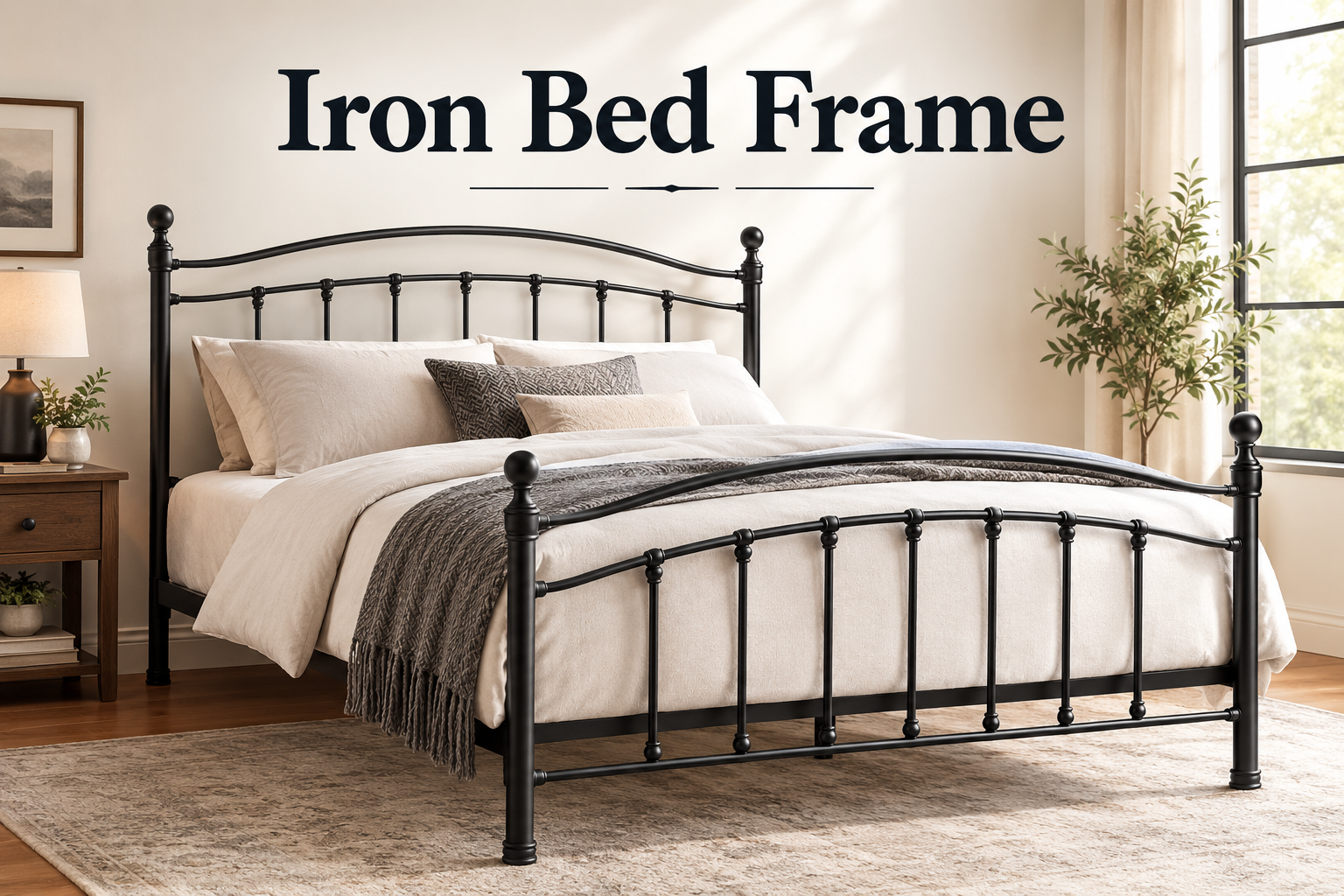
An iron bed frame is a metal bed structure designed to support a mattress directly or support a foundation beneath the mattress. Traditional iron beds are associated with decorative metalwork, curved rails, spindles, posts, and ornate headboards. Modern versions can look much simpler, with straight lines and minimalist frames.
One complication is terminology.
Retailers frequently use words such as iron, metal, steel, and wrought iron somewhat differently. A product marketed as an “iron bed” may not necessarily be made from traditional wrought iron. Some contemporary metal beds use steel construction while adopting the visual style historically associated with iron furniture.
That means the material name alone should not determine your purchase. Look at the actual specifications, support structure, finish, connections, and weight rating.
Iron vs. Steel vs. Wrought Iron
These terms are related but are not interchangeable.
Iron is a broad material category, while steel is an iron-based alloy. Traditional wrought iron has a long history in furniture and decorative metalwork, but modern furniture products can use steel or combinations of materials while still being marketed using “iron bed” terminology.
For buyers, the practical question is less “Which label sounds stronger?” and more:
How is the frame constructed?
Look for:
- Strong side rails
- Secure connections
- Appropriate center support
- Adequate mattress support
- A durable protective finish
- Clearly stated dimensions
- A stated weight capacity when available
Architectural Digest’s current metal-bed coverage reflects this modern market: products described as metal beds may use iron or steel, with different construction methods and different box-spring requirements.
Are Iron Bed Frames a Good Choice?
They can be an excellent choice when the construction matches your mattress and room.
Advantages of an Iron Bed Frame
Strong visual character: Open metal designs can become the centerpiece of a bedroom without the bulk of a fully upholstered or solid-panel frame.
Style flexibility: Traditional curved iron beds can work in vintage, farmhouse, cottage, traditional, or romantic rooms, while cleaner metal frames can fit modern and industrial interiors.
Open appearance: The gaps between rails, spindles, and posts can make the furniture visually lighter than a large solid headboard.
Easy surface care: Many painted or coated metal surfaces can be maintained with routine dusting and gentle cleaning, subject to the manufacturer’s care instructions.
Long-term usefulness: A properly built frame can provide years of service, but durability depends much more on construction quality and support design than on the word “iron” in the product title.
Potential Drawbacks
Iron-style beds are not perfect for every room.
A decorative frame can be wider or taller than expected. Heavy frames can also be difficult to maneuver during a move. Some designs require a foundation, while others are designed as platforms with mattress-support slats.
Metal connections may also develop noise when fasteners loosen, or surfaces move against each other.
The important point is that a beautiful frame is not automatically a well-designed frame.
Types of Iron Bed Frames
Traditional Iron Bed
Traditional designs usually emphasize curved lines, decorative posts, finials, vertical spindles, and detailed headboards or footboards.
They work particularly well when the bed is intended to be the main visual feature of the room.
Modern Metal Bed
Modern designs generally reduce decorative elements and use clean lines, simple rails, and understated finishes.
These are useful for bedrooms where you want the structure of the bed to complement rather than dominate the interior.
Platform Iron Bed
A platform-style bed incorporates a support system that is designed to hold the mattress without necessarily requiring a separate box spring or foundation.
However, never assume “platform” automatically means every mattress is compatible. The actual slat spacing and support construction still matter.
Canopy Iron Bed
Canopy designs add an upper framework around the mattress. They can create a dramatic bedroom centerpiece, but their additional height makes room measurements particularly important.
Check ceiling height, ceiling fans, lights, beams, and other overhead features before ordering.
Headboard and Footboard Designs
Some buyers want an iron headboard primarily for appearance while using a separate mattress-support system.
Others want a complete bed with matching headboard, footboard, side rails, and support components.
Before purchasing, verify exactly what is included. Retail listings can distinguish between a headboard-only product and a complete bed system.
Choosing the Right Iron Bed Frame Size
The correct size begins with the mattress.
U.S. Mattress Size Chart
| Mattress size | Common U.S. dimensions |
| Twin | 38″ × 75″ |
| Twin XL | 38″ × 80″ |
| Full/Double | 53″ × 75″ |
| Queen | 60″ × 80″ |
| King | 76″ × 80″ |
| California King | 72″ × 84″ |
These are common U.S. mattress dimensions; individual manufacturers can have slight variations.
Which Size Should You Choose?
Twin: Useful for a single sleeper, child’s room, compact guest space, or small bedroom.
Twin XL: Adds five inches of length compared with a standard Twin and is common in college and dorm settings.
Full: Provides more width than Twin without the footprint of a Queen.
Queen: A versatile choice for many adult bedrooms and a common option for couples.
King: Provides significantly more width than Queen and needs a larger room footprint.
California King: Trades some width for additional length and can make sense when extra sleeping length matters more than maximum width. A standard California King is commonly 72″ × 84″.
Mattress Size vs. Finished Bed Dimensions
This is one of the easiest buying mistakes to make.
A 60-inch Queen mattress does not mean your iron bed will be 60 inches wide.
The completed bed may be wider because of:
- Headboard posts
- Footboard posts
- Side rails
- Decorative elements
- Finials
- Frame construction
- Clearance around the mattress
The same applies to length and height.
Before buying, write down both:
Mattress dimensions: 60″ × 80″ for a common Queen
Finished bed dimensions: whatever the manufacturer states for the assembled frame
Retailers specifically distinguish between mattress size and overall furniture dimensions because they serve different purposes.
Check Mattress Support Before Buying
The support system is arguably more important than the decorative design.
Different mattresses have different requirements.
Sealy, for example, states that a suitable slatted frame can be used when its specified support conditions are met, including slat width and maximum spacing. Purple gives a different specific requirement for its mattresses, recommending slats no more than 3.5 inches apart when a compatible slatted base is used.
That difference is exactly why you should check your mattress manufacturer’s requirements rather than rely on a universal internet rule.
Slats
Slats are the horizontal or supporting pieces beneath the mattress.
Before buying, determine:
- How many slats are included
- How wide they are
- How far apart they sit
- Whether they are metal or wood
- Whether they are reinforced
- Whether additional support legs are included
A frame with attractive headboard details but inadequate mattress support is not a good purchase.
Center Support
Queen- and King-size systems can put substantial loads on the center of the frame.
Look for a suitable center rail and support legs reaching the floor when the design requires them.
Sealy’s warranty guidance, for example, calls for suitable center support on certain Queen, King, and California King setups and specifies particular support conditions for slatted frames.
Box Springs and Foundations
There is no universal rule that every iron bed needs a box spring.
Some metal beds use integrated slats and support a mattress directly. Others are designed around a foundation.
Current metal-bed reviews illustrate both arrangements: some frames use slats and do not require a box spring, while other designs specifically require one.
Always verify the individual bed’s specifications.
Adjustable Bases
An adjustable base can introduce another compatibility issue.
Even when an adjustable base physically fits inside a decorative bed, the interior dimensions, rails, support bars, attachment points, and clearance must be suitable.
Sealy advises measuring the inside of an existing frame when checking adjustable-base compatibility because non-standard or antique designs may not fit.
How to Judge Iron Bed Frame Quality
A quality frame should not have to rely entirely on attractive photography.
1. Look at the Connections
Examine how the headboard, footboard, rails, and supports connect.
Weak or poorly designed connection points can contribute to movement and noise.
2. Look for Adequate Support
Ask whether the frame has:
- Center rails
- Center legs
- Cross supports
- Proper slat spacing
- A platform surface
- An approved foundation system
3. Check the Weight Rating
A manufacturer’s weight rating is more useful than simply calling a frame “heavy duty.”
Remember that total load can include:
person or people + mattress + foundation + bedding + other supported weight
Do not substitute a generic internet estimate for the manufacturer’s stated rating.
4. Inspect the Finish
For painted or coated metal, check the finish description.
A protective coating can help protect the underlying metal from ordinary exposure, but no finish should be treated as completely immune to damage.
Scratches, chips, prolonged moisture, or damaged coating can create opportunities for corrosion.
5. Consider Repairability
A frame that uses replaceable hardware and accessible connections may be easier to maintain than one with components that are difficult to service.
This matters particularly for buyers who expect to keep the furniture for many years.
Iron Bed Frame vs. Wood vs. Steel
| Feature | Iron-style frame | Wood frame | Steel frame |
| Appearance | Traditional to modern | Warm and natural | Modern to industrial |
| Decorative potential | High | High | High |
| Construction variety | Very wide | Very wide | Very wide |
| Weight | Can be substantial | Varies | Often varies by tubing/design |
| Mattress support | Depends on design | Depends on design | Depends on design |
| Rust consideration | Yes, if coating is damaged and moisture reaches metal | Not a rust issue | Yes, depending on finish/material |
| Best buying criterion | Construction + support | Construction + support | Construction + support |
The important lesson is that material alone does not determine quality.
A poorly designed steel frame can be less satisfactory than a well-designed iron frame, but a well-engineered steel frame can also be an excellent choice.
Treat construction specifications as more meaningful than marketing labels.
How to Measure Your Bedroom
Measure the assembled bed, not just the mattress.
Step 1: Measure the wall
Make sure the headboard can fit without blocking:
- Doors
- Windows
- Outlets
- Switches
- Wall vents
- Sconces
- Trim
Step 2: Mark the footprint
Use painter’s tape to mark the frame’s full width and length on the floor.
This is a simple way to discover whether the bed will leave enough walking space.
Step 3: Measure beside the bed
Consider where your nightstands will go and whether drawers or cabinet doors can still open.
Step 4: Check the foot of the bed
Leave enough space to walk around the footboard.
Step 5: Measure the ceiling
This is especially important for a tall headboard or canopy.
Step 6: Measure the delivery route
A bed that fits your bedroom may still fail to fit through:
- Exterior doors
- Interior doors
- Hallways
- Staircases
- Tight corners
- Elevator doors
Check the dimensions of the individual components and packaging as well as the assembled frame.
How to Reduce Squeaking and Prevent Rust
Why can an iron bed frame squeak?
Squeaking can occur when connected components shift against each other or when hardware becomes loose.
A practical troubleshooting sequence is:
- Remove bedding and mattress.
- Identify where the sound originates.
- Check all accessible fasteners.
- Tighten hardware according to the manufacturer’s instructions.
- Check whether rails or supports are shifting.
- Look for damaged or worn connection components.
- Replace damaged hardware when appropriate.
Do not simply overtighten bolts; excessive force can damage hardware or components.
How do you prevent rust?
Keep the frame dry and follow the manufacturer’s cleaning instructions.
For a coated frame:
- Clean gently
- Avoid abrasive products that can damage the finish
- Dry moisture promptly
- Inspect scratches or chips
- Repair damaged finish using an appropriate product when permitted by the manufacturer.
Rust prevention becomes particularly important if the frame is exposed to persistent moisture.
Common Buying Mistakes
Buying based only on the mattress size
A Queen mattress may fit the sleeping area, but the full frame can require considerably more floor space.
Assuming every iron bed includes a foundation
Some have integrated support; others do not.
Ignoring slat spacing
Your mattress may have specific support requirements.
Choosing by appearance alone
Decorative posts and a beautiful finish cannot compensate for poor structural support.
Forgetting delivery measurements
Large headboards and footboards can be difficult to navigate through stairs and narrow hallways.
Assuming “heavy duty” is a specification.
Treat “heavy duty” as marketing language unless the manufacturer provides an actual weight rating or useful construction information.
Assuming all King beds are interchangeable
A standard King and California King are different sizes. A standard King is commonly 76″ × 80″, while California King is 72″ × 84″.
Forgetting mattress thickness
A very thick mattress can change the finished height of the bed and may obscure decorative portions of the headboard or footboard.
Iron Bed Frame Buying Checklist
Before placing your order, verify:
Mattress
- Mattress size confirmed
- Mattress manufacturer’s support requirements checked
- Mattress thickness measured
Frame
- Overall width confirmed
- Overall length confirmed
- Overall height confirmed
- Weight rating checked
- Materials identified
- Finish identified
- Support system understood
Foundation
- Slats included?
- Slat spacing confirmed?
- Center rail included?
- Center legs included?
- Foundation required?
- Box spring required?
- Adjustable-base compatibility confirmed?
Bedroom
- Wall width measured
- Walking space checked
- Nightstand space checked
- Ceiling height checked
- Doors and drawers can open
Delivery
- Exterior doorway measured
- Hallways measured
- Stairs checked
- Elevator checked, if applicable
- Package/component dimensions reviewed
Purchase terms
- Assembly requirements understood
- Delivery terms reviewed
- Return policy reviewed
- Special-order/customization terms reviewed
The Bottom Line
The best iron bed frame is not simply the most ornate, largest, or most expensive option. It is the one that fits your mattress, provides the required support, works with your room, can be delivered through your home, and suits the way you want the bedroom to look.
Start with the mattress size. Then check the actual bed dimensions, support system, center reinforcement, weight rating, finish, and compatibility requirements.
Once those details are correct, style becomes much easier to choose.
Ready to shop? Compare frames using the checklist above, and prioritize verified specifications over photographs or vague terms such as “heavy duty” or “premium metal.”
FAQs
Does an iron bed frame need a box spring?
Not always. Some iron bed frames are designed with integrated slats or platform support and can hold a mattress directly, while others require a box spring or foundation. Check both the frame specifications and your mattress manufacturer’s support requirements.
Are iron bed frames durable?
A well-constructed iron or metal frame can be durable, but the material name alone does not guarantee quality. Look at the frame’s joints, rails, support system, finish, weight rating, and overall construction before buying.
Can you put a memory foam mattress on an iron bed frame?
Yes, potentially, but the frame must provide the type and amount of support required by the mattress manufacturer. Slat width and spacing can affect compatibility. For example, Sealy and Purple publish specific support requirements for their mattresses.
What is the difference between a King and California King iron bed frame?
A standard King is commonly 76 inches by 80 inches, while a California King is commonly 72 inches by 84 inches. California King provides more length but less width, so the frames are not interchangeable unless a manufacturer specifically designs the product for both sizes.
How far apart should iron bed slats be?
There is no single spacing rule that applies to every mattress. The correct spacing depends on the mattress manufacturer’s requirements. For example, Sealy specifies slats no more than 4 inches apart for certain setups, while Purple specifies no more than 3.5 inches for its mattresses.
Do iron bed frames squeak?
They can squeak when joints, fasteners, rails, or other parts move against each other. Check and tighten accessible hardware according to the manufacturer’s instructions and inspect the connection points if noise develops.
Can an iron bed frame rust?
Yes, exposed or damaged metal can corrode when conditions allow moisture to reach it. Keeping the frame dry and maintaining its protective finish can help reduce the risk of corrosion.
Is an iron bed frame better than a wooden bed frame?
Neither is automatically better. The right choice depends on your preferred style, construction quality, mattress-support requirements, room layout, maintenance expectations, and budget. A well-built frame of either material can be a good choice.
You May Also Like Jernsenger