






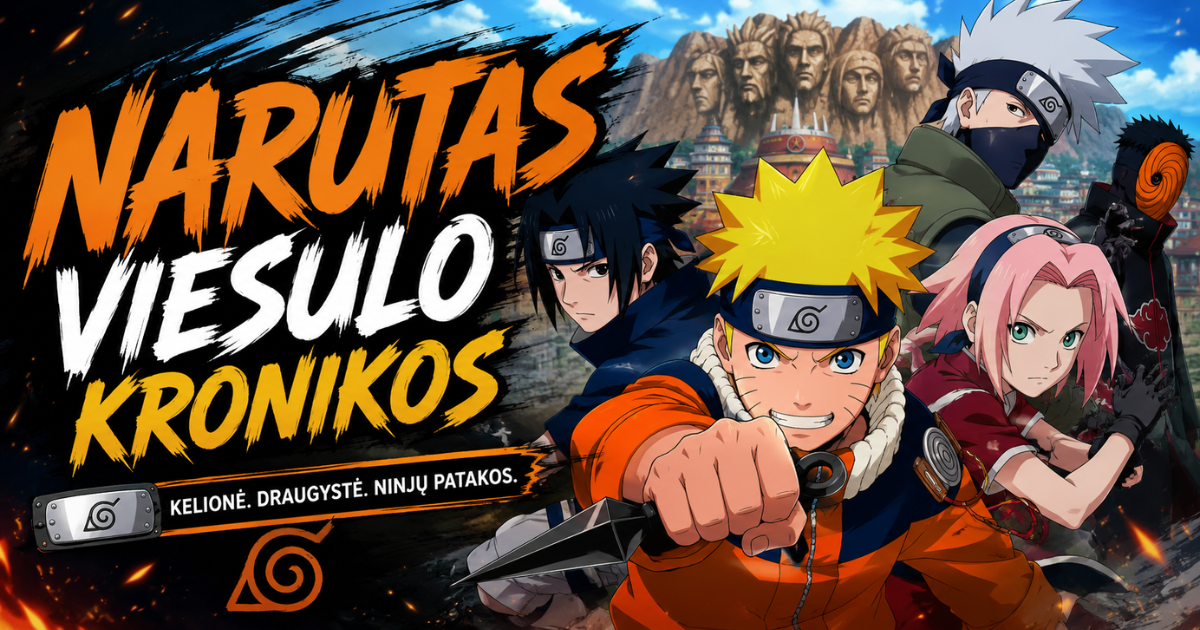
Narutas Viesulo Kronikos is the Lithuanian title commonly associated with the anime series Naruto: Shippuden. It continues Naruto Uzumaki’s story after the original Naruto series, following his return from training as he faces the Akatsuki, searches for Sasuke, and becomes involved in a conflict affecting the entire ninja world.
Lithuanian-language entertainment listings use the title Narutas: Viesulo kronikos, while fan-maintained dubbing records identify it as a Lithuanian voice-over version of Naruto: Shippuden. The underlying series is the Japanese anime based primarily on the second part of Masashi Kishimoto’s Naruto manga.
This guide explains the title, story, characters, episode count, viewing order, and legal ways to find the series. It avoids major ending spoilers, although it discusses the general premise and names of several major story arcs.
Key Takeaways
- Narutas Viesulo Kronikos refers to the Lithuanian localization or regional title associated with Naruto: Shippuden.
- The story begins roughly two and a half years after Naruto leaves the Hidden Leaf Village to train with Jiraiya.
- It is a direct continuation of the original Naruto anime rather than a remake.
- Naruto: Shippuden contains 500 episodes and originally aired in Japan from 2007 to 2017.
- Season numbering can differ between broadcasters, streaming platforms, and regional websites.
- Lithuanian-language broadcast information is mainly preserved through entertainment indexes and fan-maintained records rather than a complete official archive.
- Streaming availability and audio-language options depend on the viewer’s country.
What Is Narutas Viesulo Kronikos?
Narutas Viesulo Kronikos is a Lithuanian rendering of the title Naruto: Shippuden. Lithuanian websites commonly write it as Narutas: Viesulo kronikos, sometimes with a colon and sometimes without one.
The word viesulas can mean a whirlwind or tornado, while kronika means a chronicle. A natural English interpretation of the title is therefore Naruto: Chronicles of the Whirlwind or Naruto: Whirlwind Chronicles.
This matches the general idea conveyed by the Japanese subtitle Shippūden, which is commonly represented in English branding as Shippuden rather than translated literally.
Quick series facts
| Detail | Information |
| International title | Naruto: Shippuden |
| Lithuanian title | Narutas: Viesulo kronikos |
| Original creator | Masashi Kishimoto |
| Source material | Part II of the Naruto manga |
| Japanese broadcaster | TV Tokyo |
| Animation production | Pierrot |
| Original Japanese run | 2007–2017 |
| Total episodes | 500 |
| Main character | Naruto Uzumaki |
| Previous series | Naruto |
| Later continuation | The broader Boruto storyline |
Official franchise materials credit Masashi Kishimoto for the original story and art, list Hayato Date among the principal directors, and provide the Japanese cast, staff, episode information,n and story overview.
Is Narutas Viesulo Kronikos the Same as Naruto: Shippuden?
Yes. Narutas Viesulo Kronikos is not a separate Naruto sequel or spin-off; it is the Lithuanian title used for Naruto: Shippuden.
Regional television channels and distributors frequently translate or adapt anime titles for local audiences. A translated title may consequently look like a different production even when the episodes, characters, and main storyline are the same.
The association is supported by Lithuanian-language season listings and a fan-maintained Lithuanian media record identifying Narutas. Viesulo kronikos as the localized version of the 2007–2017 series.
However, detailed claims about the Lithuanian broadcast—such as exact premiere dates, complete voice credits, or the number of episodes shown by a particular channel—should be treated cautiously unless they are supported by an archived broadcaster schedule or distributor record.
How Does It Differ from the Original Naruto Series?
The original Naruto anime follows Naruto during his early ninja training. It introduces Team 7, the Chunin Exams, Orochimaru, the rivalry between Naruto and Sasuke, and Naruto’s ambition to become Hokage.
Naruto: Shippuden, or Naruto’s Viesulo Kronikos, begins after a substantial time jump. Naruto returns to the Hidden Leaf Village after spending approximately two and a half years training with Jiraiya. Sakura, Sasuke, Gaara and the other young ninja have also developed new skills or taken different paths.
The continuation generally has:
- Older versions of the original characters.
- More dangerous and politically complex conflicts.
- A greater focus on the Akatsuki organization.
- Deeper exploration of the Tailed Beasts.
- More information about Naruto’s family and the history of the ninja world.
- Larger battles involving several villages and generations of shinobi.
The official series summary begins with Naruto’s return and quickly introduces Gaara’s kidnapping by the Akatsuki, establishing both the higher stakes and the organization’s pursuit of the Tailed Beasts.
The Story of Narutas Viesulo Kronikos
Naruto returns to the Hidden Leaf Village expecting to reunite with his friends and demonstrate the results of his training. He soon discovers that the ninja world has become more dangerous.
The Akatsuki, a group of exceptionally powerful rogue ninja, has begun targeting the hosts of the Tailed Beasts. Because Naruto carries the Nine-Tailed Fox within him, the organization’s mission is directly connected to his survival.
At the same time, Naruto remains determined to bring Sasuke Uchiha back to the village. Sasuke has chosen a darker path in pursuit of the power needed to confront his brother, Itachi. The separation of Team 7 becomes one of the story’s central emotional conflicts.
The series gradually expands from personal rescue missions into political rivalries, hidden histories, and a war involving the major shinobi nations. Its largest conflicts test Naruto’s belief that understanding and cooperation can interrupt cycles of revenge.
Major story phases
A spoiler-light breakdown includes:
The Kazekage rescue
Naruto, Sakura, and Kakashi respond after Gaara, now the Kazekage of the Hidden Sand Village, is captured. This opening phase introduces the Akatsuki as an immediate threat and shows how much the returning characters have grown.
The search for Sasuke
Naruto and his allies investigate Orochimaru’s activities and attempt to reconnect with Sasuke. New Team 7 members Sai and Yamato are introduced during this period.
Akatsuki conflicts
Different members of the Akatsuki confront the Hidden Leaf and its allies. These stories explore the backgrounds, abilities and motivations of several villains rather than presenting the organization as a single faceless enemy.
Pain and the Hidden Leaf
Naruto’s training and personal beliefs are tested during one of the series’ most important confrontations. The storyline examines grief, revenge, political violence, and the possibility of reconciliation.
The Five Kage Summit
The leaders of the major ninja villages meet as the political situation deteriorates. Sasuke’s decisions become increasingly important to both Naruto and the wider shinobi world.
The Fourth Great Ninja War
Former enemies form an alliance against a shared threat. This lengthy phase reveals major parts of the world’s history and brings together characters from different villages and generations.
Post-war stories
The final episodes explore the consequences of the war and adapt or draw from related light novels, including stories centred on Sasuke, Shikamaru and preparations for Naruto and Hinata’s wedding. Official franchise materials credit these related novels and their authors among the sources used for the later anime stories.
Main Characters
Naruto Uzumaki
Naruto is an energetic Hidden Leaf ninja who wants to become Hokage and earn genuine recognition from his village. His role as the host of the Nine-Tailed Fox makes him powerful but also places him in danger.
His greatest strengths are not limited to combat. Naruto repeatedly tries to understand why opponents act as they do and searches for alternatives to endless revenge.
Sasuke Uchiha
Sasuke is Naruto’s former teammate and rival. His desire to avenge the destruction of the Uchiha clan drives many of his choices.
Although Naruto wants to restore their friendship, Sasuke believes that pursuing his goals alone is necessary. Their conflicting ideas about loyalty, justice and leadership shape the series.
Sakura Haruno
Sakura trains under Tsunade and becomes a highly capable medical ninja. She gains improved physical strength, medical knowledge and battlefield responsibility during the time between the two series.
She remains emotionally connected to both Naruto and Sasuke while developing a more independent role in Team 7.
Kakashi Hatake
Kakashi is the original leader of Team 7. He acts as a teacher, strategist and link to earlier generations of Hidden Leaf history.
Several later episodes examine his youth, his service in the ANBU and the losses that influenced his personality.
Gaara
Gaara becomes the Kazekage of the Hidden Sand Village. Like Naruto, he grew up carrying a Tailed Beast and experiencing fear and isolation.
His transformation from Naruto’s enemy into a respected leader demonstrates how an individual can change after receiving understanding and support.
Jiraiya
Jiraiya is one of the Legendary Sannin and Naruto’s teacher. He helps Naruto strengthen his techniques and understand the responsibilities attached to power.
His history is also connected to several important figures outside the Hidden Leaf Village.
The Akatsuki
The Akatsuki consists of rogue ninja with different backgrounds, abilities and motives. Although its members cooperate in capturing the Tailed Beasts, the organization’s deeper purpose is revealed gradually.
Official franchise character and cast listings include Naruto, Sasuke, Sakura, Kakashi, Jiraiya, Itachi, Gaara, Pain, Obito, Madara and other central figures.
How Many Episodes Does Narutas Viesulo Kronikos Have?
Naruto: Shippuden has 500 episodes. It began broadcasting on TV Tokyo on February 15, 2007, and ended on March 23, 2017.
Some platforms organize those episodes into 22 seasons, while other websites or regional distributors use different season divisions. Crunchyroll describes the series as running for 22 seasons, while a Lithuanian-language entertainment index lists 21 numbered Viesulo kronikos seasons.
This does not necessarily mean episodes are missing. Season numbering is often created for television schedules, streaming interfaces or home-video releases rather than being a fixed part of the original narrative.
Why episode numbers may look different
Viewers may encounter inconsistencies because:
- A platform can combine several Japanese story arcs into one season.
- Another platform may divide a long arc into multiple seasons.
- Television channels can purchase only part of a series.
- Some databases count the original Naruto and Shippuden separately.
- Japanese production numbers and international episode numbers may not always match.
- Regional websites may label collections according to upload batches rather than official seasons.
For dependable identification, use the episode title and the standard Shippuden episode number rather than relying only on a local season number.
Correct Naruto Watch Order
For most first-time viewers, the simplest order is:
- Naruto
- Naruto: Shippuden / Narutas Viesulo Kronikos
- The Last: Naruto the Movie
- The post-war Shippuden episodes
- Boruto-related stories
The original Naruto anime contains 220 episodes and establishes the friendships, rivalries and decisions that lead directly into Shippuden. The official Naruto website describes Shippuden as resuming Naruto’s story after about two years have passed.
Where does The Last: Naruto the Movie fit?
A practical viewing position is after Shippuden episode 493 and before episodes 494–500. The final seven episodes focus on events surrounding Naruto and Hinata’s wedding, while The Last develops their relationship before those celebrations.
The other Naruto movies are generally optional for understanding the principal manga-derived storyline. They can still be enjoyable as additional missions or alternate adventures.
Should You Watch Every Episode?
That depends on what type of experience you want.
Watch everything when:
- You enjoy side characters and additional missions.
- You do not mind slower pacing.
- You want the full television experience.
- You are interested in anime-original stories.
- You are rewatching the series for nostalgia.
Use a streamlined watch list when:
- You mainly want the manga-derived storyline.
- You have limited viewing time.
- Long flashback sections interrupt your enjoyment.
- You want to reach the central conflicts more quickly.
Anime-original episodes are often called filler. These episodes were not directly adapted from the main manga storyline, although some expand character backgrounds or provide entertaining side adventures.
Not all filler is worthless. Arcs involving Kakashi’s ANBU period and certain Tailed Beast stories are frequently recommended because they add context, even though they are not required to follow the primary plot.
Before skipping an entire block, read a spoiler-free description. Some episodes combine manga material with anime-original scenes, so a simple “skip or watch” label may hide useful content.
[Internal link: complete Naruto filler guide → Naruto and Naruto Shippuden filler list]
Is There a Lithuanian Version?
Lithuanian-language websites preserve season listings under Narutas: Viesulo kronikos, and a fan-maintained Lithuanian media database describes the program as a Lithuanian voice-over that aired on BTV.
However, a complete official record confirming every Lithuanian episode, narrator, broadcast date and rerun could not be located through currently accessible broadcaster sources. For that reason, claims about the regional version should distinguish between:
- Verified franchise facts, supported by Naruto’s official website, TV Tokyo, VIZ or licensed streaming services.
- Regional archive information, preserved through old schedules, local entertainment websites and fan-maintained dubbing databases.
- Unverified uploads, which may use the Lithuanian title without identifying the original broadcaster or rights holder.
A television voice-over can also differ from a conventional animated-series dub. In a voice-over production, the original dialogue may remain faintly audible while one or more narrators translate the speech.
Where Can You Watch Narutas Viesulo Kronikos Legally?
The most reliable approach is to search for the international title Naruto: Shippuden on licensed services available in your country.
Crunchyroll maintains a Naruto: Shippuden series page as well as a separate international-dubs collection. However, the episodes, subtitles and audio tracks available to an individual viewer can vary by region.
The official Naruto website also warns that supported streaming services differ according to the viewer’s country.
Use this process:
- Search for Naruto: Shippuden, not only the Lithuanian title.
- Open the audio and subtitle menu before subscribing.
- Confirm how many episodes the service carries.
- Check whether the listing is available in Lithuania or your current country.
- Look for Lithuanian audio, English subtitles or another acceptable language.
- Avoid assuming that an “international dubs” page automatically includes Lithuanian.
Streaming catalogues change as licensing agreements expire or move between services, so availability should always be checked directly.
What Makes the Series Worth Watching?
Narutas Viesulo Kronikos combines action with a long-form coming-of-age story. Its most memorable conflicts are not simply contests of strength; they often involve characters shaped by war, isolation, discrimination or personal loss.
Several qualities distinguish the series:
Long-term character development
Naruto’s growth unfolds across hundreds of episodes. Relationships established during the original series continue to change as the characters become older and accept greater responsibilities.
Complex antagonists
Many opponents have understandable grievances even when their methods are destructive. The series regularly asks whether pain creates more pain and whether anyone can deliberately break that pattern.
Emotional rivalries
Naruto and Sasuke’s relationship operates as friendship, competition and ideological conflict. Their connection provides the emotional foundation for much of the story.
Expanding world-building
The story gradually introduces other villages, political leaders, clan histories, ancient conflicts and the origins of important ninja abilities.
Distinctive music and visual identity
The official series materials document a large collection of opening and ending themes, including well-known tracks such as “Blue Bird,” “Sign” and “Diver.”
Common Mistakes When Researching the Title
Treating it as an unrelated anime
The Lithuanian wording can make the title look like a separate production. Search for Naruto: Shippuden when consulting international databases.
Confusing it with the original Naruto
Narutas Viesulo Kronikos begins after the original series. Starting with it is possible, but many character decisions will lack context.
Assuming every season list is identical
Streaming services and regional sites divide the same 500 episodes differently. Compare episode numbers and titles instead of season labels alone.
Trusting any site that uses the Lithuanian title
An exact-match page is not automatically an official source. Check whether it identifies a broadcaster, distributor, episode title or licensing service.
Assuming Lithuanian audio is currently available
A historical Lithuanian broadcast does not guarantee that the same voice-over is offered by today’s streaming platforms.
Skipping every anime-original episode automatically
Some optional stories provide worthwhile character development. Choose a viewing plan based on your available time and interests.
Best Viewing Plan for New Fans
A balanced approach works well for most viewers:
- Watch the original Naruto storyline or read a detailed recap.
- Begin Naruto: Shippuden from episode 1.
- Follow the manga-derived episodes during major plot sections.
- Include well-reviewed anime-original arcs involving characters you enjoy.
- Watch The Last: Naruto the Movie near the end.
- Complete episodes 494–500.
- Continue to Boruto only when you are ready for a new generation and a different storytelling focus.
This plan preserves the main emotional progression without requiring every optional episode.
Final Verdict
Narutas Viesulo Kronikos is best understood as the Lithuanian title associated with Naruto: Shippuden, the direct continuation of Naruto Uzumaki’s original anime journey. It follows an older Naruto as he confronts the Akatsuki, tries to save Sasuke and becomes involved in events that transform the entire shinobi world.
New viewers should begin with the original Naruto whenever possible, use standard Shippuden episode numbers when comparing season lists and verify current audio options through licensed regional services. Anyone researching the historic Lithuanian version should also distinguish official production information from fan-preserved broadcast records.
FAQ Section
What does Narutas Viesulo Kronikos mean?
Narutas Viesulo Kronikos can be translated approximately as “Naruto: Whirlwind Chronicles.” It is the Lithuanian title commonly associated with Naruto: Shippuden.
Is Narutas Viesulo Kronikos different from Naruto: Shippuden?
No. It is a Lithuanian localized title for the same underlying anime series rather than a separate sequel or spin-off.
How many episodes are in Narutas Viesulo Kronikos?
The complete Naruto: Shippuden series contains 500 episodes. It originally aired in Japan from February 2007 to March 2017.
Do I need to watch the original Naruto first?
Watching the original Naruto first is strongly recommended because it introduces Team 7, Sasuke’s departure, Naruto’s early training and the relationships continued in Shippuden.
Was Narutas Viesulo Kronikos available with Lithuanian voices?
Lithuanian-language listings and fan-maintained media records indicate that a Lithuanian voice-over existed, but a complete official archive of its episodes and production credits is not readily available.
Where can I watch Narutas Viesulo Kronikos legally?
Search licensed regional services for Naruto: Shippuden. Crunchyroll carries the series in supported regions, but episode, subtitle, and audio availability can differ by country.
Can Naruto Shippuden filler episodes be skipped?
Yes. Anime-original episodes can usually be skipped without losing the main manga-derived storyline, although several optional arcs add useful character background.
What comes after Narutas Viesulo Kronikos?
The Last: Naruto the Movie fits near the end of the Shippuden timeline, followed by the final wedding-related episodes and then stories focusing on Naruto’s generation and their children.
Read About Caricatronchi


