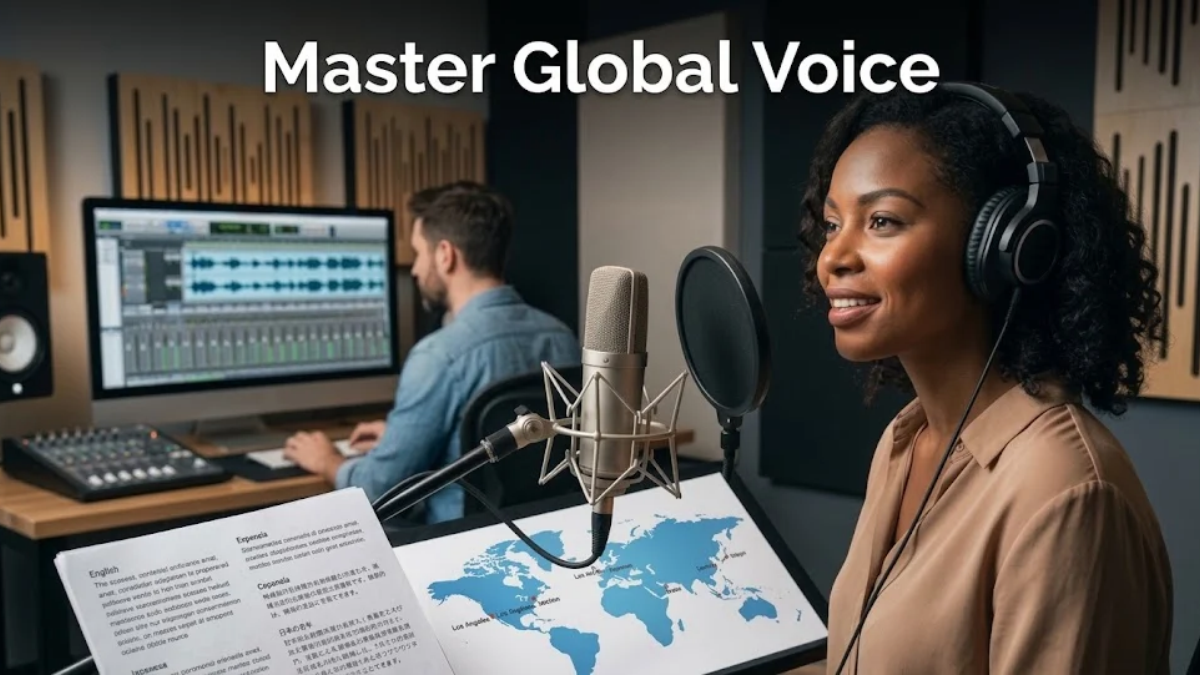
Master Global Voiceovers means creating spoken content that sounds natural, accurate, culturally appropriate, and technically consistent for audiences in different markets. It involves much more than translating a script: the language, voice, delivery, terminology, cultural references, recording quality, and usage rights all need to work together.
Master Global Voiceovers: What Does It Really Mean?
A global voiceover is designed for people who may speak different languages, use different regional expressions, or expect a different communication style.
That means a successful project starts with the audience, not the microphone.
A company producing one training video for the United States, Spain, Brazil, Japan, and Germany may need five different localized versions rather than one English recording with translated subtitles. The appropriate voice, pronunciation, pacing, terminology, and cultural references can vary by market.
The existing search landscape also treats global voiceovers as a combination of localization, authentic talent, and technical production rather than simple text conversion.
Why Translation Alone Is Not Enough
Translation focuses on meaning between languages. Voiceover localization has a wider job.
A direct translation may be grammatically correct but still sound unnatural when spoken aloud. A joke may lose its effect. A product name may require different pronunciation. A sentence that fits comfortably into an English video may become longer or shorter after localization.
This is why the production team should evaluate the spoken version of the localized script rather than approving translated text in isolation.
For advertising, entertainment, e-learning, gaming, and corporate communication, the goal is not simply to make words understandable. The goal is to make the content feel appropriate for the people hearing it.
What Makes a Global Voiceover Sound Local?
Three things matter especially: language accuracy, cultural fit, and performance quality.
Language accuracy includes pronunciation, grammar, terminology, and regional language preferences. Cultural fit covers references, humor, formality, idioms, and communication style. Performance quality includes tone, pacing, emotion, clarity, and consistency.
A native speaker can therefore be valuable even when a translator has already completed the written localization.
The person approving the final audio should be able to answer a simple question: Would a target-market listener hear this as natural communication, or as translated content?
How to Build a Global Voiceover Workflow
A reliable workflow starts before recording.
1. Define the target markets
List the countries, languages, and regional variants required.
Do not automatically treat a language as one uniform market. Spanish, for example, may require different choices depending on whether the audience is in Spain, Mexico, or another market.
2. Establish the brand voice
Document the desired personality before local recording begins.
Decide whether the voice should feel authoritative, conversational, instructional, warm, youthful, technical, premium, or energetic.
The description should be specific enough that different voice actors can interpret it consistently.
3. Prepare the master script
Create a controlled source script with approved terminology, product names, numbers, pronunciation notes, and instructions for difficult passages.
This reduces variation between versions.
4. Localize before recording
The localized script should be reviewed for meaning, cultural relevance, spoken flow, and timing.
Avoid treating translation as the final stage of the process. Recording should begin only after the spoken script is ready.
5. Cast the voice
Choose the voice based on audience fit rather than language alone.
Consider age impression, regional accent, vocal energy, genre experience, pronunciation ability, and whether the delivery style fits the project.
6. Record and edit
Record each market according to consistent technical requirements.
Editing should remove unwanted noise, mistakes, distracting pauses, and inconsistent takes without making the performance sound unnatural.
7. Review and test
Before publication, check terminology, names, numbers, pronunciation, timing, tone, and technical quality.
For important campaigns, a native-market reviewer should listen to the final files rather than reviewing only the written scripts.
Choosing Voice Talent for Different Markets
There is no universal rule that the same voice should represent a brand in every country.
Using one recognizable voice can support brand continuity, while different local voices may create a stronger sense of authenticity. The correct choice depends on the brand, content type, audience, and distribution strategy.
For example, an international software company may want a consistent communication style across markets while still using different native speakers. A character-driven entertainment project may require distinct local performances rather than a unified corporate sound.
The important point is to define the relationship between global consistency and local authenticity before casting.
Localizing the Script Before Recording
Some of the most expensive mistakes happen before a voice actor enters the studio.
Look for:
- idioms that do not translate naturally
- humor that depends on local knowledge
- words with multiple pronunciations
- brand names requiring special pronunciation
- numbers, dates, currencies, and measurements
- technical terminology
- references that may not make sense in the target market
- sentences whose translated length changes synchronization
A strong workflow can also maintain a terminology sheet. This gives every language team the same approved vocabulary for recurring products, features, departments, and technical concepts.
Recording and Mixing for Consistent Quality
Localization can fail even when the translation is excellent.
Different recordings may have noticeably different microphone characteristics, room sound, volume, background noise, or processing. When several languages appear in one campaign, those differences can make the project feel inconsistent.
The production specification should therefore define the recording and delivery requirements before sessions begin.
Review the final files for:
Clarity: speech should remain easy to understand.
Consistency: similar content should not vary dramatically in perceived level or processing.
Cleanliness: unwanted noise, clicks, distortion, and room problems should not distract from the performance.
Timing: dialogue should fit the intended visual or instructional flow.
Human Voice Actors vs AI Voiceovers vs Hybrid Workflows
The choice between human and synthetic voice production should depend on the project’s requirements.
| Factor | Human Voice Actors | AI Voiceovers | Hybrid Workflow |
| Natural performance | Strong potential | Can be highly natural but varies | Can combine strengths |
| Emotional nuance | Strong | Depends on system and use case | Useful for selected content |
| Localization flexibility | Strong with native talent | Broad and scalable | Broad |
| Production speed | Usually slower | Usually faster | Moderate |
| Scalability | Requires more coordination | High | High |
| Rights review | Contract and usage terms matter | Licensing and consent are critical | Both must be reviewed |
| Best fit | Brand-critical and performance-led work | High-volume or flexible content | Large multilingual programs |
AI voice technology can support multilingual production, but it does not remove the need for rights and consent checks. For example, ElevenLabs states that its Professional Voice Clone workflow verifies ownership of the voice and does not allow users to create a Professional Voice Clone of another person’s voice.
The broader legal environment also matters. WIPO’s materials describe international and domestic issues around performers’ rights, while current SAG-AFTRA materials emphasize consent, compensation, and control in AI-related voice use.
A hybrid workflow can be useful when a project needs human performances for brand-critical scenes but wants automation for selected internal, instructional, or high-volume content.
The Rights and Consent Questions You Should Not Skip
A voice recording is not only an audio file.
Before releasing a professional or synthetic voiceover, clarify who owns or licenses the performance, where it can be distributed, how long it can be used, whether it can be modified, and whether synthetic or cloned versions are permitted.
This is particularly important when AI is involved.
WIPO notes that performers have rights connected to their performances, while the international legal position can differ depending on the type of performance and national law.
Contracts and platform terms should therefore be reviewed for the actual project rather than assuming that one license model applies everywhere.
Common Global Voiceover Mistakes
One common mistake is treating translation as localization.
Another is selecting a voice only because it speaks the requested language. A technically fluent speaker may still be the wrong fit for the audience, tone, or regional variant.
Projects also fail when the original script changes after localized recording has begun. Even a small change can trigger rerecording in several languages.
Another overlooked issue is quality control. A multilingual campaign can look complete in a project-management system while still containing a pronunciation error, incorrect number, missing line, or timing problem in one market.
How to Quality-Check Multilingual Audio
Use a repeatable review process rather than relying on one final listen.
First, compare every localized script with the approved source. Then verify pronunciation, numbers, names, terminology, and cultural adaptation.
Next, review the audio without looking at the script. This helps reveal awkward phrasing and performance problems that may be missed during text review.
Finally, compare the finished audio with the video or presentation where synchronization matters.
For large projects, maintain a market-by-market QA checklist so corrections can be tracked instead of handled informally.
When Global Voiceovers Make the Most Sense
Global voiceovers are particularly useful when spoken communication is central to the experience.
Examples include:
E-learning: localized narration can make training easier to follow for international learners.
Marketing: local voice talent can help a campaign feel designed for its target market.
Corporate communication: organizations can produce multilingual training, onboarding, and internal communications.
Gaming and entertainment: performance, character identity, and cultural adaptation can all influence the localization approach.
Product videos: demonstrations and explainers can be adapted for multiple markets without rebuilding the entire production from scratch.
Is Mastering Global Voiceovers Worth the Effort?
It is useful when the audience, message, and distribution strategy genuinely cross language or regional boundaries.
The strongest results usually come from treating the work as a localization system, not merely as a translation task. That means controlling the source script, adapting the spoken content, choosing suitable talent or technology, maintaining technical consistency, and checking rights before release.
The biggest efficiency gain does not necessarily come from recording faster. It often comes from reducing preventable rework through better planning.
A global voiceover project is therefore best measured by more than the number of languages delivered. The better question is whether each version is accurate, natural, technically sound, legally usable, and appropriate for its intended audience.
Comparison Table
| Factor | Human Voice Actors | AI Voiceovers | Hybrid Workflow |
| Best for | Performance-led content | High-volume production | Mixed production needs |
| Main advantage | Human expression and nuance | Speed and scalability | Balance of flexibility and human control |
| Main limitation | More coordination and recording time | Rights, quality, and authenticity considerations | More workflow complexity |
| Cost/value | Depends on talent, markets, usage, and sessions | Often attractive for scalable workflows | Depends on how tasks are divided |
| Difficulty | Casting and scheduling | Tool selection and quality control | Requires clear process ownership |
| Best use case | Advertising, entertainment, important branded narration | Large-volume or selected content | Multilingual programs with varied requirements |
Conclusion
Master Global Voiceovers is best understood as a complete localization and production process rather than simply recording translated scripts. Strong results come from combining appropriate local language choices, suitable voices, culturally adapted scripts, controlled production standards, careful QA, and clear usage rights.
AI can be part of that workflow, but it should not eliminate attention to consent, licensing, quality, or audience expectations. Current guidance from WIPO, SAG-AFTRA, and voice-platform documentation demonstrates why those issues deserve explicit review.
You may also like: Messonde
FAQs
What is the difference between global voiceovers and multilingual translation?
Translation changes the written language. Global voiceover production also adapts the spoken delivery, pronunciation, tone, pacing, and cultural context for the target audience.
Should I avoid global voiceovers if my content is already subtitled?
Not necessarily. Subtitles and localized voiceovers serve different viewing preferences and accessibility needs. Voiceover becomes more valuable when spoken delivery is central to comprehension or engagement.
What is the long-term impact of AI on global voiceovers?
AI is likely to make multilingual production faster and more scalable, but projects will still need decisions around quality, authenticity, rights, and human oversight. Current industry materials already emphasize consent and control for AI-related voice use.
What practical issue do companies overlook most?
They often underestimate the rework caused by changing source scripts after localization has started. Locking terminology and the master script early can prevent repeated recording work.
When should I choose human voice actors instead of AI?
Use human performers when emotional nuance, character performance, brand identity, authenticity, or audience trust is central to the project. AI may be more suitable where speed, scalability, or controlled content variation is the primary requirement.