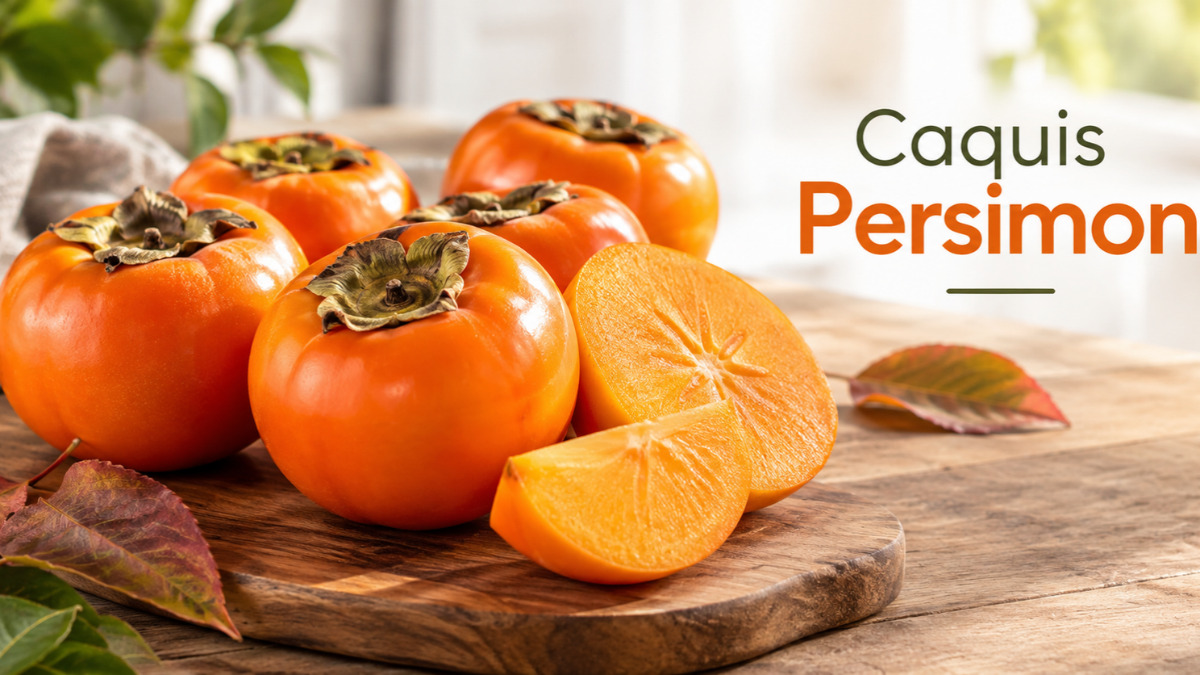
Caquis Persimon are firm, crisp kakis associated with the Persimon trademark of the Kaki Ribera del Xúquer DOP, rather than a separate botanical species. They are particularly known for their orange color and firm flesh, allowing them to be eaten in a way that is closer to an apple than to a traditional soft, fully mature kaki.
What Are Caquis Persimon?
The word “Persimon” can cause confusion because many people use it as though it were the name of a separate variety. According to the DOP Kaki Ribera del Xúquer, Persimon® is a registered trademark, not a botanical variety. It identifies kakis from the relevant denomination that are prepared for firm, crisp consumption.
The variety behind the DOP product is Rojo Brillante. When its astringency is removed using appropriate post-harvest techniques, the fruit can be consumed while its flesh remains firm and crisp.
Is Persimon® a Variety of Kaki?
No. This is one of the most useful distinctions for anyone searching for Caquis Persimon.
The DOP explains that Persimon® is a registered commercial designation. The same Rojo Brillante variety can also be consumed in its traditional soft form, commonly identified by the DOP as “Classic.” The important difference is therefore not simply the fruit species, but the form of consumption and treatment used to remove astringency.
| Characteristic | Persimon® | Classic Kaki |
| Flesh | Firm and crisp | Soft and gelatinous |
| Typical color | Orange | Deeper red/orange when mature |
| Astringency | Removed for firm consumption | Reduced through natural ripening |
| Eating style | Sliced or eaten like a firm fruit | Usually eaten when very soft |
| Relationship to Rojo Brillante | Same variety can be used | Same variety can be used |
What Makes Persimon® Different From Classic Kaki?
The biggest practical difference is texture.
A traditional Classic kaki is normally enjoyed when it becomes very soft. Persimon®, by contrast, is prepared so that its astringency is removed while the fruit remains firm. This gives it a crisp texture and makes it easier to slice, transport, and use in dishes where the fruit needs to hold its shape.
That distinction also explains why a firm Persimon should not automatically be treated as an unripe fruit.
Where Do Kaki Persimon Come From?
The Rojo Brillante variety developed in the Ribera Alta area of Valencia. The DOP describes it as a local variety that originated naturally through spontaneous mutation from another local variety, Cristalino, around the middle of the twentieth century.
The broader Kaki Ribera del Xúquer designation is linked to the agricultural area around the Xúquer River in Valencia. European documentation describes the protected product as fresh fruit of the Rojo Brillante variety and establishes the geographical relationship between the product and the Ribera del Xúquer area.
When Are Caquis Persimon in Season?
The usual commercial season for Persimon® from the DOP runs approximately from October through January, although exact dates can change with the weather and conditions of each campaign. The DOP’s own consumer guidance gives a similar early-October-to-late-January window.
This makes Persimon strongly associated with autumn and early winter. Outside this period, consumers may find other kaki varieties originating from different countries.
How to Choose a Good Persimon®
Color is useful, but it should not be considered in isolation.
The DOP recommends paying attention to whether the fruit is predominantly orange rather than substantially green. At the beginning of a campaign, some green coloration around the calyx can be normal when the rest of the fruit is orange. Excessive green coloration can indicate that the fruit was picked or marketed before reaching the appropriate stage.
Small superficial marks are also not automatically a quality problem. The DOP notes that kaki has delicate skin and can develop surface marks from contact with branches and leaves during growth.
When buying certified fruit, look for the relevant DOP identification and the Persimon® designation on the fruit or packaging.
How Should You Eat Caquis Persimon?
A properly identified Persimon® is ready to eat while firm. You do not need to wait for it to become completely soft. Its crisp texture makes it particularly convenient to slice and serve as fresh fruit.
Its firm flesh also makes it useful in salads, starters, and other dishes where a soft fruit would lose its structure. Food publications have used Persimon in salads, appetizers, desserts, and savory preparations, showing how its texture can work beyond simple snacking.
How Should You Store Persimon® at Home?
Persimon® is already intended to be eaten when purchased, so there is normally no need to wait for it to become soft. The DOP advises against storing these kakis in the refrigerator under normal circumstances.
You can leave them in the fruit bowl for a while if you prefer a more mature texture, but the DOP warns that Persimon® is not necessarily going to become completely soft in the same way as a traditional Classic kaki. Keeping it for too long can also reduce quality.
The fruit can also be peeled, cut into segments,s and frozen for later culinary use. After thawing, however, the raw fruit can lose some of its flavor and may be better suited to cooked preparations or frozen desserts.
Can You Use Persimon in Recipes?
Yes. The firm texture is one of the reasons Persimon works well in recipes.
Thin slices can be added to salads, while cubes can be paired with nuts, cheese, or other seasonal ingredients. It can also be incorporated into desserts and cooked dishes. Recipe collections specifically highlight the fruit for savory appetizers, salads, meat preparations, desserts,s and other seasonal combinations.
The main advantage for cooking is structural: a firm piece of Persimon can retain more shape than a fully soft kaki.
What Does the DOP Label Mean?
A DOP, or Protected Designation of Origin, connects a product with defined geographical and production requirements. The Spanish Ministry of Agriculture lists Kaki Ribera del Xúquer as a protected designation, while the DOP’s own certification information explains that its role includes certifying the product according to established requirements.
For shoppers, this means the DOP label is more useful than relying only on the word “Persimon” in a product description. The DOP advises consumers to look for the relevant certification and identification on fruit or packaging when they specifically want protected Kaki Ribera del Xúquer.
Common Mistakes When Buying Caquis Persimon
One common mistake is assuming that a hard kaki is automatically unripe. For Persimon®, firmness is part of the intended eating experience.
Another mistake is treating every fruit sold as “persimon” as identical to certified Kaki Ribera del Xúquer. The DOP specifically recommends checking the certification marks and identification when buying its protected product.
A third mistake is storing Persimon in the refrigerator by default. The DOP recommends keeping these fruits out of the refrigerator under normal home-storage conditions.
Is Caquis Persimon Right for You?
Caquis Persimon are particularly practical for people who like kaki but prefer a firm, crisp texture. They are also useful when the fruit needs to be sliced, transported, or incorporated into recipes without becoming immediately soft. The traditional Classic form remains a different eating experience, with soft flesh and a more mature texture.
The most important point is simple: Persimon® describes a protected commercial form of kaki, not a completely separate fruit species. Understanding that distinction makes it easier to choose, eat and store the fruit correctly.
Comparison Table
| Factor | Persimon® | Classic Kaki |
| Texture | Firm and crisp | Soft and gelatinous |
| Astringency | Removed for firm consumption | Reduced through ripening |
| Typical use | Fresh eating, slicing, salads, recipes | Spoon eating, soft preparations |
| Storage guidance | Generally not refrigerated | Depends on ripening stage |
| Relationship to Rojo Brillante | Same variety can be used | Same variety can be used |
Conclusion
Caquis Persimon combine the familiar sweetness of kaki with a firm, crisp eating texture. The most important distinction is that Persimon® is a registered designation associated with qualifying Kaki Ribera del Xúquer rather than the name of a separate species or botanical variety.
For shoppers, checking the DOP identification, looking for appropriate orange coloration, avoiding unnecessary pressure on the fruit,t and storing it correctly can help preserve its intended quality.
You may also like: Kouskousi
FAQs
Are Caquis Persimon the same as persimmons?
They belong to the kaki/persimmon fruit group, but Persimon® is a registered trademark used by the DOP to identify a specific certified form of the product.
Should I avoid Caquis Persimon if they are firm?
No. Firmness is one of the defining characteristics of the Persimon® form. It is intended to be eaten firm and crisp.
Can Persimon become completely soft?
It may become more mature if left out, but the DOP notes that Persimon® does not necessarily become completely soft like the traditional Classic form.
Is a green Persimon always bad?
Not necessarily. Some green coloration around the calyx can occur at the beginning of the season, but the DOP says that a fruit with more green surface than orange should generally not be selected for consumption.
What is the most overlooked buying detail?
The certification label matters when you specifically want protected Kaki Ribera del Xúquer. The DOP recommends checking the fruit or packaging for its identification rather than relying only on a generic product name.