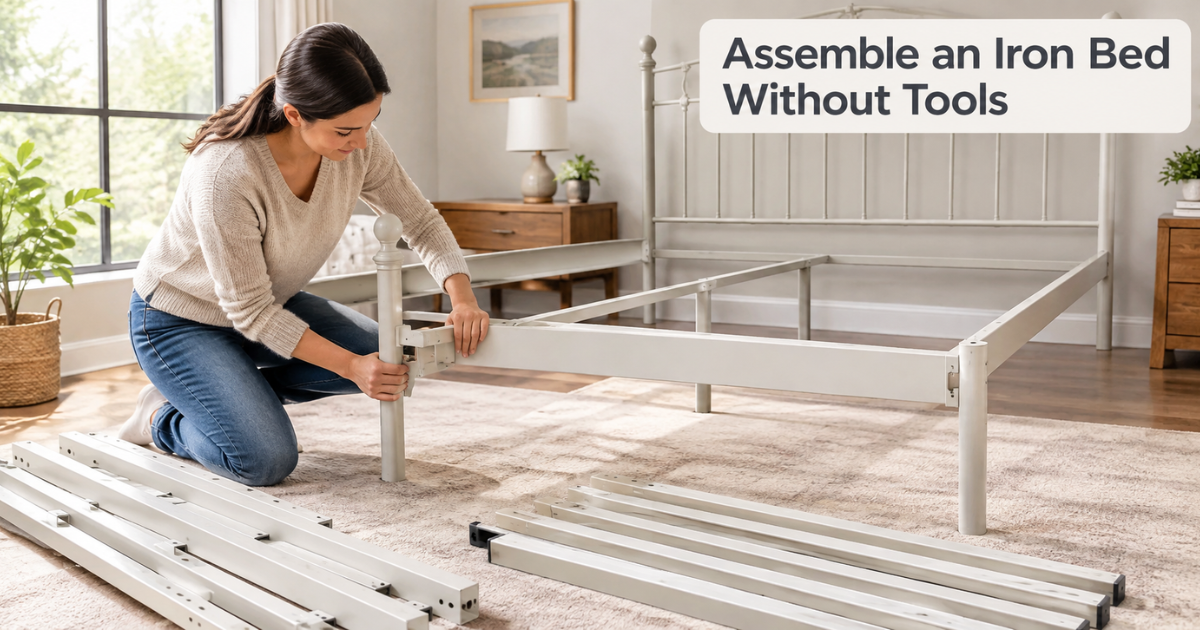
You can assemble an iron bed frame without tools if it’s designed with tool-free, interlocking, pin-lock, or bracket connections. The basic process is to lay out the parts, align the frame sections, lock the rails together, install the support structure and slats, and then check every connection before putting the mattress on.
Not every iron bed uses this type of construction, so do not remove or improvise hardware simply because you want a tool-free installation. Follow the instructions supplied with your particular frame whenever they differ from the general process below.
Can You Really Assemble an Iron Bed Frame Without Tools?
Yes, but the design matters.
Modern tool-free metal frames are available with quick-lock or interlocking systems that avoid screws and additional tools. Some models connect by sliding frame sections together, while others use brackets, pins, or slots that lock when the pieces are pressed into position.
The phrase “without tools” does not mean “without assembly.” You still need to position the frame correctly and make sure every connection is fully engaged.
What to Check Before You Start
Move the box close to the room where the bed will be used. Assemble the frame on a clean, flat surface so the metal does not become scratched while you are working. Manufacturer instructions commonly recommend unpacking the parts and checking the inventory before beginning.
Look through the instructions before connecting anything. Identify the headboard and footboard, side rails, center support pieces, legs, brackets, pins, and slats. Your frame may not contain all of these parts, and some models combine several components into one section.
This quick inspection can prevent one of the most frustrating assembly problems: discovering halfway through the job that two apparently similar pieces actually belong in different positions.
How to Assemble an Iron Bed Frame Without Tools
Start by Laying Out Every Part
Place the major frame sections on the floor approximately where they will go. Keep matching components together and orient the finished bed in the direction you want it to face.
For frames with separate side rails, position the rails parallel to each other. Some tool-free designs recommend building a lighter end section first and then joining it to the headboard, which can make the frame easier to handle.
Do not begin by randomly connecting pieces. The frame becomes much easier to understand when the major sections are laid out in their approximate final positions.
Connect the Main Frame Sections
Look for the connection mechanism on the frame. Depending on the design, it may be a slot, bracket, pin, hook, tab, or interlocking metal joint.
Bring the two pieces together slowly and align the connection points. Then slide, insert, or press them together according to the manufacturer’s design.
A properly designed tool-free frame should not require you to hammer, twist aggressively, or bend the metal to make the parts fit. Current tool-free designs commonly rely on interlocking joints or quick-lock connections rather than screws.
Lock the Side Rails and End Sections
Once the first connection is engaged, repeat the same process on the other side.
For bracket-style beds, the connection may require posts to enter matching holes before the frame section is pressed downward to lock. For other models, the rail may slide directly into a receiver or lock into an integrated joint.
Check the connection visually before moving on. The rail should sit at the intended height and should not appear partially inserted.
This is one of the most important stages of assembly because an apparently connected frame is not necessarily a correctly locked frame.
Add the Center Support
If your iron bed has a center rail or center support legs, install them before fitting the mattress.
Center support systems vary considerably. Some frames use a central beam with one or more feet, while others use several cross-support pieces. The purpose is to transfer load through the frame toward the floor rather than leaving the mattress support dependent only on the outer rails.
Do not substitute a random metal bar or wooden block for a missing structural component. If the center support is absent from the package, check the parts list and contact the seller or manufacturer rather than improvising.
Fit the Iron or Metal Slats
After the main frame is stable, install the slats.
Many tool-free frames use slats that fit into matching slots or grooves. The correct orientation matters because a slat that is upside down or incompletely seated may fail to sit flush. One manufacturer’s tool-free instructions specifically direct users to press the slats fully into their matching slots and flip them if they do not sit correctly.
Work across the frame rather than concentrating on one area. Each slat should be properly seated before you continue.
Do not assume that every frame requires a box spring. Some platform-style metal frames are designed for the mattress to sit directly on the slat system, while other bed designs require a box spring or bunkie board.
How to Check That the Frame Is Secure
Before putting the mattress on the bed, inspect every connection.
Look at both side rails and make sure they sit evenly. Check that the center support reaches the floor correctly. Press gently on different areas of the frame and look for obvious movement, separation, or rocking.
A useful check is to compare the left and right sides. If one rail is visibly higher, one connection may not be completely engaged.
Do not use the mattress to hide an assembly problem. It is much easier to correct a misaligned rail or slat while the frame is empty.
Common Problems During Tool-Free Assembly
One common problem is misalignment. The parts may look as though they fit together, but the connection points are slightly offset. In that situation, separate the pieces and realign them rather than forcing them together.
Another problem is an incomplete lock. A bracket can appear connected while still sitting too high, or a slat can rest across the frame without actually being seated inside its slot.
A third problem is missing or incorrect parts. Similar-looking rails and supports are not necessarily interchangeable.
Tool-free assembly should reduce the need for equipment; it should not encourage force. If a connection requires excessive pressure, bending, drilling, or hammering, stop and check the instructions for that specific model.
When You Should Not Force a Connection
Never force two metal pieces together simply because they appear to belong together.
Forcing a connection can damage the coating, bend a rail, deform a bracket, or make the final frame uneven. It can also create a situation where the frame looks assembled but does not properly lock.
A tool-free system is designed around its connection method. The correct approach is normally controlled alignment followed by sliding, pressing, inserting, or locking.
If your instructions specifically call for a rubber mallet or another tool, then the frame should not be treated as a completely tool-free assembly. Tool requirements vary by design.
How to Prevent Squeaking and Wobbling
Most assembly-related wobbling starts with something that is not fully seated, aligned, or supported.
Check the joints first. Then check the center support and legs. Finally, inspect the slats to make sure they are sitting correctly.
Keep the frame on a reasonably level surface. If the manufacturer’s design includes rubber feet or anti-slip pads, make sure they remain correctly positioned. Some current tool-free metal frames specifically use anti-slip components as part of their stability design.
If a correctly assembled bed later begins to squeak, identify the actual movement point before adding anything to the joints. The source could be a loose connection, slat movement, floor contact, or another component.
Is a Tool-Free Iron Bed Frame Strong Enough?
Tool-free assembly does not automatically mean a bed frame is weak.
Strength depends on the frame’s construction, materials, support geometry, joints, legs, slat arrangement, and manufacturer-rated load capacity. Some current metal platform frames advertise substantial weight capacities, but those numbers are model-specific and should never be applied to a different bed frame.
The better question is not simply whether the bed needs tools. It is whether the finished frame has been assembled according to its design and whether its published specifications match your intended use.
What to Do After Assembly
Once the frame is completely assembled, make one final inspection before adding bedding.
Check the rails, support legs, center structure, and every slat. Confirm that the frame is sitting squarely and that there are no visibly loose or disconnected components.
Then follow the manufacturer’s instructions for the mattress or foundation. If the bed is designed for direct mattress support, place the correct mattress on the completed slat system. If the design requires a box spring or another foundation, use the specified foundation instead.
The most important idea is simple: tool-free does not mean guess-free. The safest and easiest assembly comes from matching each part to its intended connection and confirming that it is fully seated before moving to the next stage.
Conclusion
Assembling an iron bed frame without tools is straightforward when the frame is specifically designed for tool-free installation. Lay out the components first, align the main sections carefully, lock the rails, install the center supports and slats, and inspect every connection before using the bed.
The biggest mistake is assuming that every metal bed can be assembled the same way. Follow the frame’s own connection system, never force a joint that does not align, and verify the completed structure before adding the mattress.
You may also like: Are Iron Beds Strong?
FAQs
Can I assemble any iron bed frame without tools?
No. Only frames designed for tool-free or hardware-free assembly can reliably be installed this way. A conventional frame may require screws, bolts, an Allen key, or another tool.
Should I avoid an iron bed frame that needs tools?
Not necessarily. Tool requirements are mainly a matter of design. A tool-free frame emphasizes convenience, while a conventional frame may use a completely different fastening system.
Will a tool-free bed frame become loose over time?
It can develop movement if a connection is not correctly seated, a component is damaged, or another structural issue develops. Regularly check the frame if you notice wobbling or new noise.
What is the most commonly overlooked assembly step?
Checking that every slat and locking connection is fully seated. A frame can look complete while one component is still incorrectly positioned.
What should I do if the frame does not fit together?
Stop rather than forcing the metal. Recheck the part orientation and assembly instructions, verify that you’re connecting the correct components, and contact the manufacturer if a part appears defective or missing.