
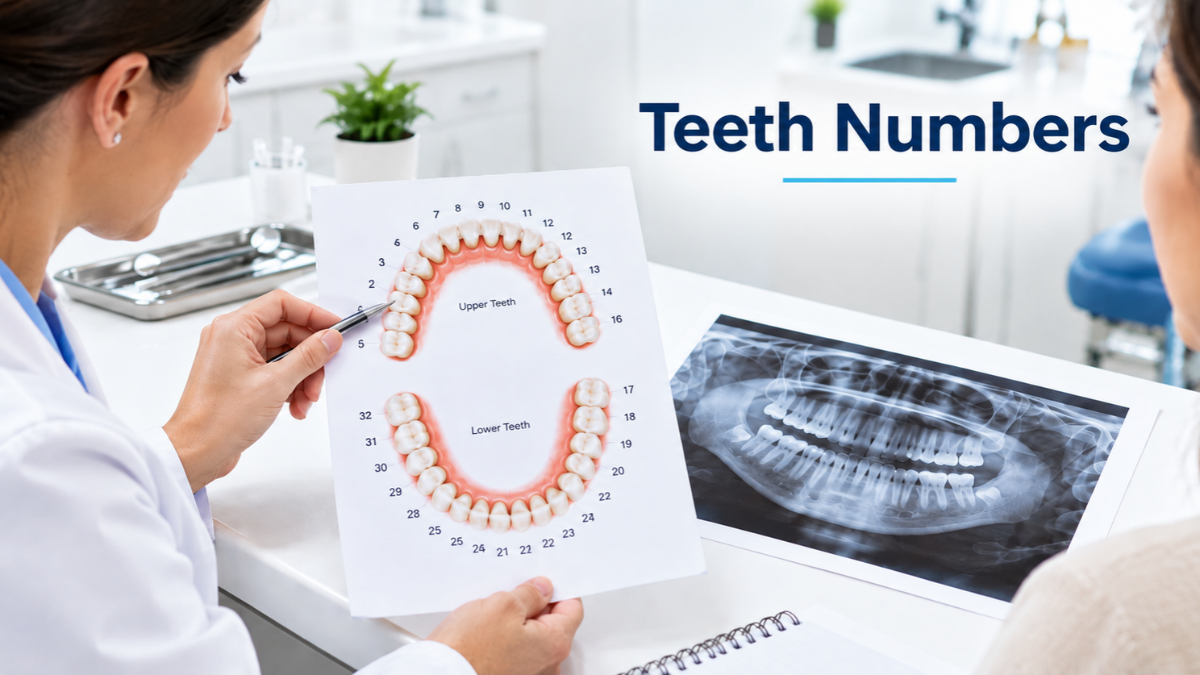
Teeth numbers are identification codes dentists use to record and discuss individual teeth. The exact number depends on the numbering system being used, with the Universal system common in the United States and FDI notation widely used internationally.
What Do Teeth Numbers Mean?
When a dentist says something such as “tooth #3” or “tooth #14,” the number identifies a specific tooth rather than describing its condition.
Dental numbering makes records easier to read and helps dentists communicate about a precise location. A number can refer to an incisor, canine, premolar, or molar depending on the numbering system.
The most important point is that not every country uses the same system. This is why a tooth called #8 in one system may be called 11 in another.
Why Dentists Number Your Teeth
A dental chart needs a consistent way to identify teeth. Instead of repeatedly writing a full description such as “upper right first molar,” a dentist can use a standardized number.
Tooth numbers can appear on examination records, X-rays, treatment plans, dental claims, and clinical documentation. The ADA’s Universal Tooth Designation System is specifically used for dental records and claims in the United States.
Universal Tooth Numbers 1–32 Explained
The Universal/National Tooth Numbering System numbers permanent teeth from 1 through 32. It starts with the patient’s upper-right third molar, continues across the upper teeth, then proceeds to the lower-left side and around to the lower-right third molar.
One important detail is the viewpoint: right and left refer to the patient’s right and left, not the viewer’s.
| Universal number | Tooth |
| 1 | Upper right third molar |
| 2 | Upper right second molar |
| 3 | Upper right first molar |
| 4 | Upper right second premolar |
| 5 | Upper right first premolar |
| 6 | Upper right canine |
| 7 | Upper right lateral incisor |
| 8 | Upper right central incisor |
| 9 | Upper left central incisor |
| 10 | Upper left lateral incisor |
| 11 | Upper left canine |
| 12 | Upper left first premolar |
| 13 | Upper left second premolar |
| 14 | Upper left first molar |
| 15 | Upper left second molar |
| 16 | Upper left third molar |
| 17 | Lower left third molar |
| 18 | Lower left second molar |
| 19 | Lower left first molar |
| 20 | Lower left second premolar |
| 21 | Lower left first premolar |
| 22 | Lower left canine |
| 23 | Lower left lateral incisor |
| 24 | Lower left central incisor |
| 25 | Lower right central incisor |
| 26 | Lower right lateral incisor |
| 27 | Lower right canine |
| 28 | Lower right first premolar |
| 29 | Lower right second premolar |
| 30 | Lower right first molar |
| 31 | Lower right second molar |
| 32 | Lower right third molar |
This sequence is consistent with the ADA’s Universal Tooth Designation System and standard dental references.
The easiest numbers to remember
The four central front teeth are #8, #9, #24, and #25 in the Universal system.
The four wisdom teeth, when present, are:
#1 and #16 in the upper jaw, and #17 and #32 in the lower jaw.
How FDI Teeth Numbers Work
The FDI two-digit system works differently. Instead of numbering every permanent tooth from 1 to 32, the first digit identifies the quadrant and the second digit identifies the tooth’s position within that quadrant.
For permanent teeth, the quadrants are:
| FDI quadrant | Location |
| 1 | Upper right |
| 2 | Upper left |
| 3 | Lower left |
| 4 | Lower right |
The second digit runs from 1 at the central incisor to 8 at the third molar.
For example:
11 = upper right central incisor
21 = upper left central incisor
36 = lower left first molar
46 = lower right first molar
48 = lower right third molar
The FDI system is widely used internationally, and dental literature describes it as one of the principal systems alongside Universal and Palmer notation.
Universal vs FDI vs Palmer Notation
The same tooth can have different labels depending on the system.
| Tooth | Universal | FDI |
| Upper right central incisor | 8 | 11 |
| Upper left central incisor | 9 | 21 |
| Upper right first molar | 3 | 16 |
| Lower left first molar | 19 | 36 |
| Lower right first molar | 30 | 46 |
| Upper right third molar | 1 | 18 |
| Lower right third molar | 32 | 48 |
Palmer notation uses a quadrant symbol together with a number from 1 to 8, so it looks different again. These systems exist because dental records have historically used more than one standardized method.
What Are Baby Teeth Numbers?
Baby teeth are usually not numbered 1–32 in the Universal system. Instead, primary teeth are identified with the letters A through T.
There are normally 20 primary teeth: 10 in the upper jaw and 10 in the lower jaw.
In the Universal system, the upper primary teeth run from A to J, followed by K to T for the lower primary teeth.
This difference is important when reading children’s dental records because an adult tooth number and a primary-tooth letter do not describe the same numbering format.
Which Teeth Are Wisdom Teeth?
Wisdom teeth are the third molars, located at the very back of each quadrant.
In the Universal system, they are #1, #16, #17, and #32 when all four are present.
In the FDI system, they are 18, 28, 38 and 48.
Not everyone develops or keeps all four wisdom teeth. Some may be absent, fail to erupt, or become impacted. Dental records therefore may show a wisdom-tooth number even when the tooth is not currently visible in the mouth.
Why Tooth Numbers Can Look Different on Dental Charts
The most common source of confusion is that dental charts may use a different system from the one a patient expects.
For example, a U.S. record may identify an upper right central incisor as #8, while an FDI-based record identifies the same tooth as 11. Neither number automatically means the dentist made an error; they may simply be using different notation systems.
This distinction is particularly relevant when dental records move between countries or when information is transferred between healthcare providers. Research examining international dental records has documented differences in numbering systems across countries, including the use of FDI and Universal notation in Pakistan.
Comparison Table
| Factor | Universal System | FDI System | Palmer System |
| Basic format | 1–32 for permanent teeth | Two digits | Quadrant symbol + number |
| Common use | United States | Widely used internationally | Used in dental education and clinical settings |
| Primary teeth | A–T | Two-digit primary notation | Quadrant + letter/number convention |
| Easy patient example | Tooth #8 | Tooth 11 | Symbol + 1 |
| Main challenge | Different from international notation | Requires understanding quadrants | Symbols can be harder to type |
The ADA identifies Universal/National as the most commonly used system among U.S. dental professionals, while international dental literature recognizes FDI and Palmer as major systems as well.
How to Read Your Dental Record Correctly
First, identify which numbering system the dental office uses. Then check whether the record refers to permanent or primary teeth.
Next, determine whether “right” and “left” are being described from the patient’s perspective. This prevents one of the most common chart-reading mistakes.
Finally, match the number to a chart rather than guessing from the number alone.
A useful rule is simple: never interpret a tooth number without knowing the numbering system behind it.
Common Mistakes When Reading Teeth Numbers
One common mistake is assuming that #1 means the first front tooth. In the Universal system, #1 is actually the upper right third molar, or wisdom tooth.
Another mistake is confusing Universal numbers with FDI numbers. A tooth identified as #3 in the Universal system is an upper right first molar, while 33 in FDI notation refers to a completely different tooth.
Patients can also misunderstand right and left when looking at a dental diagram face-to-face. Dental descriptions generally refer to the patient’s own right and left.
When Should You Ask Your Dentist About a Tooth Number?
Ask for clarification whenever a dental record, treatment plan, X-ray report, or insurance document contains a tooth number you do not understand.
Knowing the number can help you follow your treatment, but the number alone does not tell you whether a tooth is healthy, decayed, cracked, infected,d or suitable for a particular procedure. Those conclusions require a dental examination and, when appropriate, imaging.
For treatment decisions, use the number as an identification label and rely on your dentist’s clinical explanation for what is happening with that tooth.
Conclusion
Teeth numbers are simply a standardized way to identify individual teeth, but the number only makes sense when you know which dental numbering system is being used. The Universal system numbers permanent teeth from 1 to 32, while the FDI system uses two-digit codes and the Universal system uses A–T for primary teeth.
The most reliable way to interpret a number on a dental chart is to identify the system first, confirm the patient’s right or left side, and then match the number with the appropriate tooth chart. That small step can eliminate much of the confusion surrounding dental records.
You may also like: Health Threetrees Com VN
FAQs
Is tooth #1 a front tooth?
No. In the Universal system, #1 is the upper right third molar, commonly called a wisdom tooth.
Should I avoid a tooth because it has a certain number?
No. A tooth number identifies location; it does not by itself indicate that a tooth is unhealthy or needs treatment.
Do tooth numbers stay the same worldwide?
No. Different regions use different dental numbering systems. The same tooth can therefore have different designations.
Why does my dentist say 36 when another chart says 19?
Those may be two different systems. #19 is the lower left first molar in the Universal system, while 36 is the lower left first molar in FDI notation.
Can baby teeth have numbers?
Yes, depending on the system. In the Universal system, primary teeth are identified with letters A through T rather than the permanent-tooth numbers 1–32.