
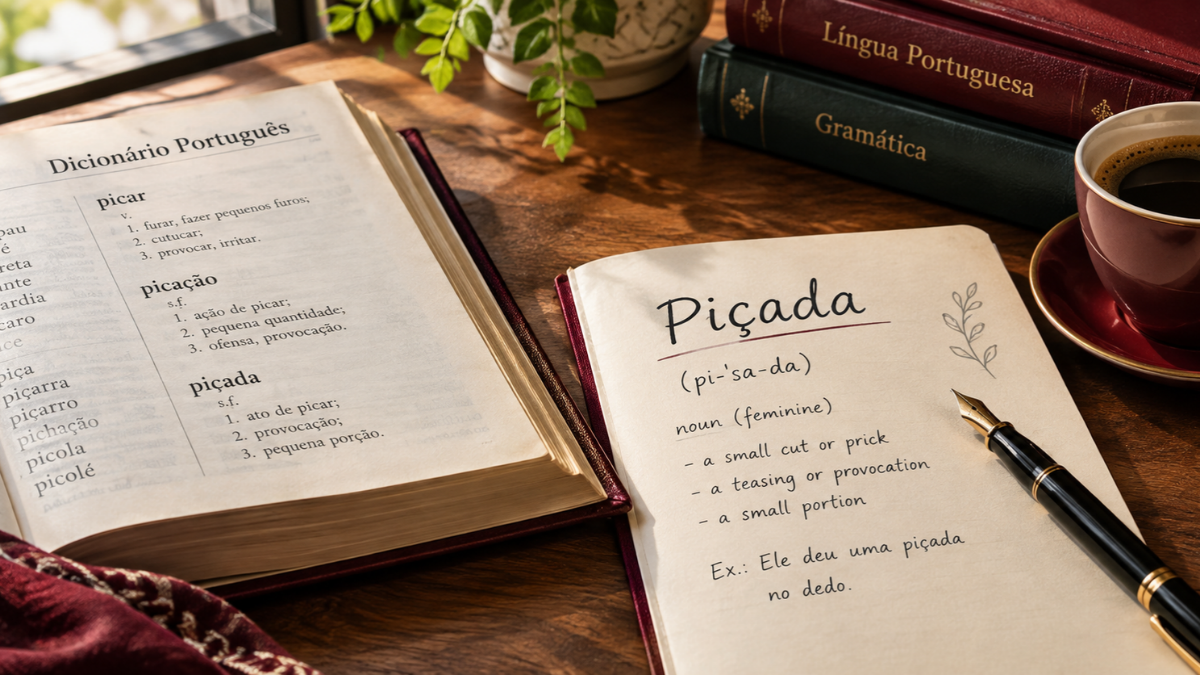
Piçada is a Portuguese slang word that can mean a harsh reprimand or telling-off. It also has a separate vulgar sexual meaning, so its interpretation depends on the context in which it appears. The Portuguese dictionary Infopédia records both meanings and traces the word in Dicionário Infopédia da Língua Portuguesa.
People encountering Piçada online may be confused by its spelling, pronunciation, or translation. Understanding its meanings is important because it is not a neutral word suitable for every conversation.
What Does Piçada Mean?
In Portuguese, Piçada can describe a strong verbal reprimand, such as being told off by a parent, teacher, manager, or another person in authority. It is informal slang and communicates a stronger sense of criticism than a neutral expression for receiving feedback.
For example, someone who makes a serious mistake at work and receives a sharp verbal correction might describe the experience using this word. An English translation could be “a telling-off,” “a dressing-down,” or “a severe reprimand,” depending on the sentence.
These English expressions communicate the first meaning without suggesting that every translation will fit every situation.
The word also has a separate vulgar meaning involving physical contact with the penis. Because this meaning is sexually explicit, it should be recognized when interpreting Portuguese conversations, even when the surrounding context makes the reprimand meaning more likely.
The Two Meanings of Piçada
Understanding Piçada requires distinguishing its two dictionary-recorded meanings rather than assuming it has just one translation.
The first meaning is a harsh reprimand. Infopédia uses Portuguese equivalents such as censura áspera, descompostura, and raspanete. These describe strong criticism or a forceful telling-off. This is the meaning relevant to discussions of informal speech and being reprimanded.
The second meaning is classified as vulgar language and refers to physical contact involving the penis. It is not interchangeable with the first meaning, and the surrounding words are important for deciding which interpretation makes sense.
This distinction matters particularly for learners who rely on automatic translations. A translation that overlooks the context may produce a sentence that sounds confusing, excessively rude, or entirely inappropriate.
How Is Piçada Used in Conversation?
When Piçada is used to mean a reprimand, it belongs to informal conversation rather than formal business or academic writing.
Consider these illustrative English examples:
A student receives a sharp telling-off after repeatedly ignoring classroom rules.
An employee receives a severe reprimand after failing to follow an important workplace procedure.
A friend describes being strongly criticized for arriving late to an important meeting.
These situations illustrate the meaning of the word, rather than claiming that the English sentences are direct Portuguese quotations.
In Portuguese, the precise expression surrounding Piçada can affect how it should be translated. A native speaker’s tone, regional habits, and relationship with the listener can also influence how a slang expression is understood.
For language learners, the safest approach is to understand the word before trying to use it. A dictionary definition provides a useful starting point, but it does not establish that the word is acceptable in every Portuguese-speaking community.
Piçada vs. Picada: What Is the Difference?
Piçada and Picada look similar, but they are different words. The cedilla in Piçada changes the pronunciation and helps distinguish it from Picada.
| Feature | Piçada | Picada |
| Language | Portuguese | Portuguese |
| Main relevant meaning | Harsh reprimand or telling-off | Prick, bite, or narrow path, among other meanings |
| Pronunciation guide | Roughly “pee-SAH-dah” | Roughly “pee-KAH-dah” |
| Register | Slang; also has a vulgar meaning | Depends on its meaning and context |
| Main caution | Can be offensive | Usually interpreted according to the specific context |
The Infopédia entry gives the pronunciation of Piçada as /piˈsadɐ/. Its entry for Picada gives /piˈkadɐ/, reflecting the sound difference between the two spellings. Picada can refer to an injury caused by something pointed, an insect sting, or a narrow path through vegetation.
For this reason, replacing one spelling with the other can change the meaning of an entire sentence. Readers should check the original spelling instead of relying only on similar-looking words.
How Do You Pronounce Piçada?
Infopédia represents the pronunciation of Piçada using the International Phonetic Alphabet as /piˈsadɐ/. The stress falls on the middle syllable.
An approximate English reading is “pee-SAH-dah,” although this is only a learning aid and does not reproduce every detail of native Portuguese pronunciation.
The letter ç is especially important. In this word, it represents an /s/ sound, whereas the c in Picada represents a /k/ sound. Listening to a Portuguese pronunciation recording can help learners hear the difference more accurately.
Is Piçada a Rude or Offensive Word?
Yes, Piçada should be treated as potentially offensive because its dictionary entry classifies the reprimand meaning as slang and the second meaning as vulgar language.
Its suitability depends on the conversation, but it is not a good default choice for professional emails, academic writing, formal presentations, or communication with people whose language preferences are unknown.
When the intended meaning is simply that someone received strong criticism, more neutral alternatives in English include “a reprimand,” “a telling-off,” or “a stern warning.” In Portuguese, the best substitute depends on the intended meaning and sentence.
Learning an informal word does not mean it is appropriate to use it. Recognizing register is an important part of understanding a language.
When Should You Avoid Using Piçada?
Avoid using Piçada when you are uncertain about the listener, the social setting, or the intended meaning. This is particularly important when speaking with colleagues, clients, teachers, strangers, or people who may interpret vulgar language differently.
In a formal setting, clear and neutral wording is usually more effective. For example, instead of choosing a slang expression to describe a workplace disagreement, use a phrase such as “a serious reprimand” or “strong criticism.”
Language learners should also avoid using a word solely because an online translation gives one convenient English equivalent. Slang often carries social meaning that cannot be captured in a single dictionary translation.
When the term appears in a message, song, comment, or video, examine the surrounding sentence before deciding which meaning is intended.
Common Mistakes When Understanding Piçada.
One common mistake is confusing Piçada with Picada. Their similar spelling can lead readers to assume they have the same meaning, even though their pronunciation and definitions differ.
Another mistake is treating Piçada as a neutral everyday expression. Its slang and vulgar classifications make context important.
A third mistake is assuming that a word has the same meaning or level of offensiveness everywhere Portuguese is spoken. A dictionary entry documents meanings, but it does not measure how frequently speakers use a word in every region.
Finally, learners sometimes translate isolated words without considering the full sentence. With Piçada, this can produce the wrong interpretation, particularly when the sexual meaning is relevant.
The most reliable approach is to check the spelling, read the full context, consult a reputable Portuguese dictionary, and choose a translation that reflects both meaning and tone.
Conclusion
Piçada is a useful example of why accurate spelling and context matter in Portuguese. Its meanings range from a strong reprimand to vulgar slang, whereas Picada has different meanings. A clear, dictionary-supported explanation gives readers the information they need without treating the word as universally appropriate or promising search rankings.
You may also like: Ksözcü
FAQs
1. What does Piçada mean in English?
It can mean a harsh reprimand, telling-off, or dressing-down. It also has a separate vulgar sexual meaning in Portuguese.
2. Is Piçada the same as Picada?
No. Piçada and Picada have different spellings, pronunciations, and meanings. Picada can refer to a prick, insect bite, or narrow path.
3. Is Piçada a formal Portuguese word?
It is recorded as slang, with an additional meaning classified as vulgar. It is therefore not a suitable default for formal communication.
4. Could the meaning of Piçada change over time?
Slang can change across generations and communities. The dictionary definition is a reliable starting point, but regional usage and future changes should be checked against current evidence.
5. How can I determine which meaning is intended?
Read the entire sentence, consider the topic and social setting, check the exact spelling, and consult a Portuguese dictionary. When context remains unclear, ask a fluent speaker rather than guessing.